5 years ago I watched the Peru presidential election debate over a cheap bottle of Peruvian wine. This time around only hard liquor will do. It is that bad. Mostly the format but the candidates aren’t anything to write home about either.
Tag Archives: Peru
Multiple guess: 2016 Peru presidential candidates
Which of the following is a candidate for president in the 2016 Peru presidential elections:
a) A drunk.
b) A cheat.
c) A guy allegedly tied to the murder of a journalist.
d) A dude who insults supporters and whose body guards beat up hecklers.
e) All of the above.
Winners and losers of the 2016 Peru presidential elections so far:
WINNER: Keiko Fujimori, because she’ll be the next Prez of Peru and has managed to present herself as a rather reasonable person and candidate in the midst of this entire farce that passes for democratic elections.
WINNER: Julio Guzman, a guy nobody knew a few months ago and became a leading candidate before getting banned by the electoral body (for now). No matter what happens in this election cycle he looks likely to be an influential politico going forward.
LOSER: Everybody who hoped there would be substantive change for the better any time soon.
LOSER: Whoever got paid to write Cesar Acuña’s thesis back in the day because you know that dude’s in deep doo-doo now that everybody knows he or she copied/pasted the whole thing.
Peru Presidential Elections 2016: F*cked up like a turkey on Thanksgiving
This time I’m worried.
Some were worried 5 years ago if Ollanta Humala were elected President of Peru he’d move the country radically left a la Venezuela but I said nothing would change, that Humala would look out for whoever paid Peru the most, ie. the Lima political/business establishment and foreign investors.
This time around however, Peru’s upcoming presidential elections have me worried. The biggest problem facing the country in my opinion is extreme institutional weakness caused by corruption and incompetence. No matter what the policies or ideological convictions of the next Prez, Peru needs to address this institutional weakness or risk becoming a failed state like Colombia in the 1980s.
Today’s news of Julio Guzman, a leading candidate in the upcoming elections, being banned from the vote after several back-and-forth decisions by the national electoral body is just one – albeit highly visible – example of the type of institutional weakness that pervades every part of society now in Peru.
As another example, a friend of ours told us one of the recent mayors of the city of Cusco created 3,000 new positions in city government for his supporters and made no effort at all to give them formal responsibilities or keep them from cleaning out the city’s coffers any way they saw fit.
Unfortunately I don’t think any of the leading presidential candidates would move to address the rampant corruption and incompetence. At the moment Keiko Fujimori is favored to win the presidency and in my opinion she would likely send Peru further down the path of a failed state if elected. I don’t think her personal qualifications or convictions are even relevant in that, what worries me is that all of her supporters who have been loyal to her father’s movement for 15+ years since her father got run out of the country will come out of the proverbial woodwork to claim their reward for 15 years of support.
If I was advising a foreign company on investing in Peru at the moment I’d say keep a clear path to the exit.
The Hartley Hooligans
There’s been a lot of media coverage about Zika lately. Among all the noise I found this great WaPo inspired life article “What this amazing mom of two girls with microcephaly has to say about Zika scare”. You should go read it too.
The WaPo article links to Gwen Hartley’s blog The Hartley Hooligans, here’s one excerpt from the blog:
It is sad to me that microcephaly is being vilified in the media due to Zika, and I hope that the general public realizes that though this diagnosis would not be something I would have chosen, I am NO LESS BLESSED by having two daughters with this condition than if they’d been born typical. I am just as proud of my girls as I am of our neurotypical son, Cal.
* * *
A long time ago when my parents worked with so-called “disabled” children there was an effort to change the terminology from “disabled” to “different-abled” children, because so-called disabled children have their own way of putting a smile on their parents’ faces and frankly they don’t grow up to do any of the horrible things the rest of us do like invent nuclear weapons or create Ponzi schemes.
I’ll be right back!
Summer vacation! The other day Mamacita Linda took a trip into town from our lovely hotel by the beach, we’d just finished lunch. She said “I’ll be right back!”
Then she took the 5 minute moto-taxi ride in town and returned just before I took this picture. Keep in mind lunch is served late in Peru and the sun sets early-ish but still, “I’ll be right back” doesn’t mean the same around here as it does where I’m from!

Sun sets over the Pacific Ocean. Mancora, Peru.
You have beautiful eyes
I went to the market in the Ttio neighborhood of Cusco yesterday, just the middle child and I. Our 3 year old is the one with kaleidoscope eyes: depending on the light (or her mood?) the color of her eyes changes from green to honey to steel blue.
Almost all Cusqueñans have dark or brown eyes but they have a big thing for light colored eyes. When I pulled out of the parking lot, the parking lot attendant took my S/.1 parking fee and said:
“You have such beautiful eyes!”
Sort of looking from afar at my daughter in the back seat she continued:
“But your kid doesn’t.”
Me: “Errghh, thanks, I think?”
Then the parking lot attendant stuck her head all the way in the car to get a closer look at my daughter.
“Oh yeah, she does too!”
I hit the gas and got out of there never to go back again. If you have light colored eyes, consider yourself warned.
Pride – Home On The Prairie
We drove out to Pampa Wasi a few weeks back, Quechua for “Home On The Prairie.” Pampa Wasi is referred to as a populated center, meaning it’s a community too small to be a town in its own right, administratively it belongs to the nearest bigger town. Pampa Wasi is about 3 hours outside of Cusco and a good 45 minutes by car away from the nearest “real” towns, Combapata and Tungasuca. I believe Pampa Wasi is here on the map.
We took a trip out there so our maid Delia could visit her 5 year old son. Delia had her baby when she was very young – I’ve been told diplomatically “it wasn’t voluntary” – and her mother insists on raising the boy in the town while Delia is working in the big city. Delia quit school to care for her baby and now she’s taking weekend classes to finish high school, so she doesn’t get a chance to see her son very often.
We met with Delia’s mom and Delia’s little boy in Combapata, because every Sunday they travel to the market in Combapata to buy their supplies for the week. When we arrived, Delia’s mom pulled out a fully cooked lunch, home grown potatoes and the fattest guinea pig I’ve ever seen, the kind you’ll pay $50 for at a fine restaurant at the Plaza de Armas in Cusco. We didn’t expect all that but Delia’s mom was worried we’d be tired and hungry from the long drive with our 3 kids.
After our yummie lunch we drove the rest of the way to Pampa Wasi, passing by this interesting looking site, it looks as if it could be an unrestored Inca ruin? It’s well known in the town, Delia says the local kids go there to play.
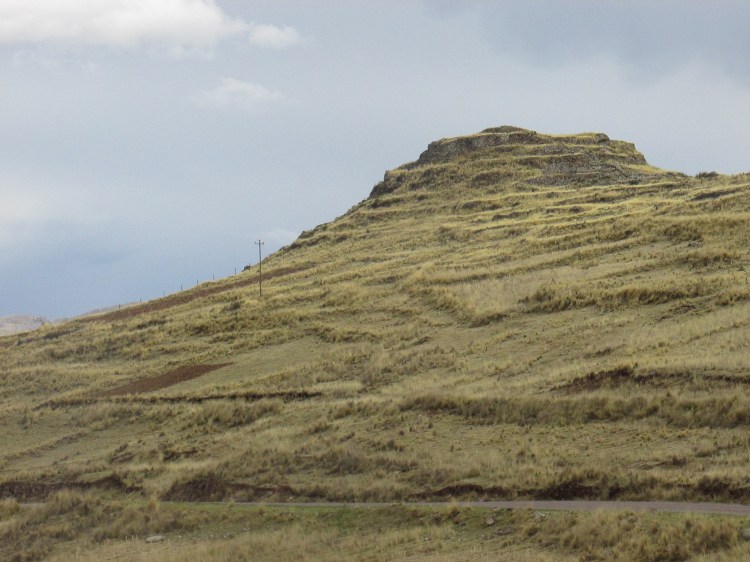
Unrestored Inca site?
Surprisingly there’s electricity and water in Pampa Wasi but other than that it’s very much “off the grid”. About 40 families live in Pampa Wasi, they live of the land, growing potatoes, herding sheep and raising guinea pigs, cuy as they’re called here. Did you know guinea pigs and chickens don’t mix? There isn’t a yardbird to be found in all of Pampa Wasi because there’s some issue with the health of the guinea pigs around chickens.
Kids go to school in Pampa Wasi till age 12, after that they have to go to school in the big towns, which means living away from home. They commute once a week in the bed of a truck, that’s the typical mode of transportation in these parts.
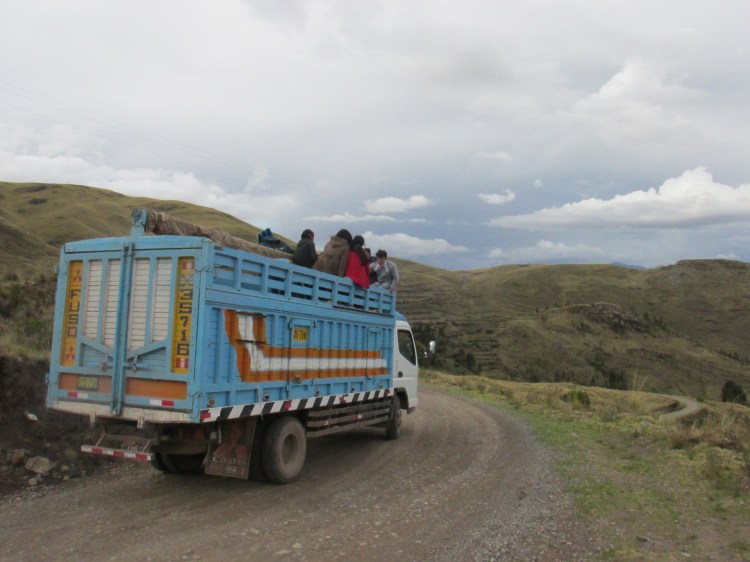
Kids commuting on a Sunday evening to go back to school the next morning.
But I wanted to tell you about pride. If you’ve never been to one of these small towns in the Andes it may be hard to comprehend the indigenous Quechua (and Aymara) are a very strong, proud people, they consider their ancestral lands sacred. Many have left their small towns to go to the cities but you’d be mistaken if you think they do so to escape the small towns, rather they all have intrinsic motivation like the rest of us to pursue opportunities and dreams. If you ask those who stay in the towns why they stay, the answer is typically “these are our lands”.
I’ll put it to you in terms of money, only because that’s what we Westerners understand: I probably make as much or more money than the entire community of Pampa Wasi but when we arrived, Delia’s mom brought food for us because she was worried about our needs.
These are NOT needy people. The amount of money you make doesn’t change the way they treat you – something we can’t say in the so called developed world.
This is also why so many mining companies have problems doing business in Peru. They venture into the Andes with an attitude like “my money is the biggest thing that’s ever going to happen to this town” and the local people not only couldn’t care less but they feel this attitude is extremely disrespectful of their ancestral lands.
On the other hand if you visit a community like Pampa Wasi and respect the people as equals, they’ll do anything for you. In fact, come hungry because the juiciest guinea pig you’ve ever tasted will be cooked and waiting for you.


Broken bones and beer
Years ago I worked with a man who lost several fingers in a work accident. As a teenager he got his hand caught in an industrial appliance in a pizza kitchen (or pizza factory). The accident caused him such shock and pain that when one of his coworkers grabbed my friend by his other hand to pull him away from the machine, he broke several bones in his coworker’s hand from squeezing her hand so hard as she pulled him away.
The other day I was on a flight from Cusco to Lima, with a stop in Puerto Maldonado. A “dogleg” in industry speak. Two ladies in traditional Peruvian clothing were sitting nearby, an older lady in the row behind me and a woman about my age next to me. I had the aisle seat and she had the middle seat with nobody by the window.
I dozed of a bit while the plane was taxiing for takeoff but when the plane lifted off I opened my eyes to look outside. As I turned my head towards the window, the woman next to me lunged towards me, grabbed my arm in such abject fear as I’ve never seen before in my life. White with fear she grabbed my hand so hard that all I could think of was my old friend breaking the bones in his coworker’s hand.
As my seat mate screamed people all around us started calling for the flight attendants. I tried every distraction I could think of:
“Where are you going?”
“First time flying?”
“You live in Cusco?”
…
While she was still wrapped around me tighter than Leo and Kate in Titanic I learned she’s from Andahuaylillas and was traveling to Lima to visit her daughter, who’d moved there to work when she was 14. After a while the flight attendants literally pried this poor woman off of me and she eventually calmed down a bit. The flight attendants were very good during this ordeal, which was almost surprising because in Peru many people get hired for customer service type positions by virtue of being young and cute, not by professional ability.
At the stopover in Puerto a young man took the window seat, he was a rather handsome European looking guy, tall, blond hair, early 20s. The flight attendants said to the lady beside me “if you have any problems now you have 2 good looking young men on either side of you to help!”
Of course I feigned surprise and excitement
“Who?!”
“Where?!?”
The woman beside me had relaxed by the time we were descending into Lima and would turn around occasionally to talk in Quechua to the older lady behind us, who was also dressed in traditional Peruvian attire. As we started to descend into Lima the older lady, who looked to be in her 80s, had a bit of a scratchy throat. One of the flights attendants asked if she wanted a cup of water.
She paused for a moment and replied: “Can I have a beer instead?”
Not in “I wanna get waisted kind of way” but rather, “It’s 5 in the afternoon, I’m 80 years old and traveling by myself, and I’d like a beer”.
A bunch of people snickered when the woman asked for a beer instead of water but the flight attendants didn’t care. In Peru jobs as flight attendants are still respected, something to be desired. Flight attendants are typically educated, ambitious, cute young people from so called “good families”. I liked that you could tell for maybe the first time in their lives, those flight attendants wanted to be just like that old traditional lady, strong and confident.
* * *
A special song for my Mamacita Linda.
Back side of the lagoon
Monday morning musings.
The moon circles the earth in 28 days, exactly the same amount of time it takes the moon to rotate around its own axis. This means that the same portion of the moon’s surface is always facing the earth – just take a pair of binoculars and look, the moon always looks the same. Until the US and Soviet space programs in the 1950s and 1960s, humans had stared at the moon for centuries but never seen the far side of the moon.
So it happens sometimes that you look from a different angle at a sight you’ve known for a long time and find yourself surprised by what you see. This weekend we took the unimproved “dirt” road from Izcuchaca to the back of the Huaypo lagoon. We’d been to the lagoon before but always from the main road between Cusco and Urubamba, I’d never been to the far end of the lagoon before. I’ve seen the Urubamba mountain range many times – and it’s always a great view – but never from this particular spot.
I’ve been fortunate in my life to have seen many beautiful places and stunning scenery. From the Greek Islands to the Florida Keys, the Yucatan to Niagara Falls. I’ve seen the Greenland Icecap and the Canadian Arctic, flew over a volcano in Iceland and stayed on the shortest street in the world. I’ve seen the Saudi desert and the Amazon jungle, Budapest, Nairobi and London too.
I think most of my traveling days are behind me now but that’s OK, to see great sights you don’t have to travel to the 4 corners of the world, all you have to do is ride out to the back side of the lagoon.

Urubamba mountain range from the back of the Huaypo lagoon
Huarocondo – Authentic Peruvian Pueblo
Hey Lyle, I stopped by the Gringo Wasi last Sunday but nobody answered the door. Not sure if you were out and about or perhaps taking your afternoon siesta?
Other than not getting together with Lyle our Sunday outing was very nice. Huarocondo is a small town about an hour outside of Cusco but unlike the towns on the typical Cusco tourist circuit, Huarocondo is authentic Peruvian. Of course “authentic Peruvian” isn’t one thing or another – it’s many different things – but the average tourist would be mistaken for believing that the towns on the tourist circuit outside Cusco (ie. Pisac, Urubamba, Ollantaytambo, Chinchero, etc) are representative of a typical small town in the Andes.
They’re not. A thousand square meters of land ( < 1/4 acre) outside Urubamba will cost you over $100K US.
Huarocondo on the other hand is a very traditional, authentic Peruvian pueblo. Lyle is the only gringo in town and barely a few dozen city slickers make their way out on the weekend to sample Huarocondo's delicious lechon. If you’re in Cusco and you want to spend a few days away from the hustle and bustle of the big tourist city, give Lyle a call and check out Huarocondo.
-

- Eating lechon at the main square of Huarocondo on a nice Sunday afternoon.
-

- Los Andenes, Inca terraces near Huarocondo, Cusco, Peru
-

- Did you have a relaxing Sunday afternoon?
 Life in Peru