Starting a business in Cusco, Peru (ICPNA I-12)

Since I’m teaching about business in my current class at ICPNA, I decided to start a class project to open a coffee shop on the Plaza de Armas in Cusco. We already have a McDonalds in Cusco and will soon have a Starbucks, so let’s give them some competition.

Our fictional business will be a fancy coffee shop with yummie breakfast, snacks, etc. We will have wireless internet, friendly service and a hip atmosphere.

Here’s what I need from my team, that is, the class:

  • Ideas for names.
  • Ideas on how to set the place up (decorations, themes, uniforms, ….)
  • What kind of things we will sell.
  • Legal stuff: how to set up a legal entity (EIRL, SA).
  • Financial plan and accounting policies. Let’s not get in trouble with SUNAT or my uncle Alan Garcia.
  • Marketing plan.
  • A good location in anywhere in beautiful downtown Cusco Peru.
  • Employees, employee manuals, policies, procedures, …
  • Ideas on how to reward our employees.
  • Policies / ideas to prevent theft from customers and employees.
  • Suppliers: where to get good food, coffee, drinks, ice cream,…. Also furnishings and furniture to open our place.
  • Lobbyist to have lunch with the mayor and governor of Cusco once a month.
  • Business plan.
  • Exit strategy, meaning, what to do if our business doesn’t work out.
  • Any other advice or items I’ve overlooked.

Write at least 2 or 3 comments before the end of our class next Friday 9/26!!!! Any thoughts and ideas are welcome, explain/justify your ideas.

Ward

My I-12 class at ICPNA
My I-12 class at ICPNA

Consulting, CIS, aviation

This month I’m going to take a big leap of faith and finally start my own business down here in beautiful Cusco, Peru. I have a lot more inspiration than money – but that’s never stopped me before. If all I wanted was a comfy job somewhere I would have stayed with GE…

Speaking of corporate America, watching what is happening in the US tempts me to seek consulting work back in the corporate world. I always felt that some corporate culture in the US dangerously drove people to fudging their numbers. I often had the outside opinion on a lot of issues, which typically got rejected quickly because we all stayed inside a certain comfort zone. I don’t claim to have a silver bullet, but at the same time all the big shot bankers and corporate executives that are now making excuses are the same people who led their companies down the primrose path of self-destruction in the first place.

Ward Welvaert

turnaround consulting
aviation/airline consulting
CIS applications

Visit to Copacabana, Bolivia!


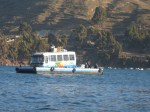
We had some trouble getting back from La Paz to Cusco due to the transportation strike in Cusco last week, so we spent a day in Copacabana waiting for the next bus back to Cusco. In my opinion this was the best part of our trip to Bolivia. Copacabana is a touristy spot on lake Titicaca, with fantastic scenery and a lot of laid-back little bars and cafes. We took a nice boat trip on lake Titicaca and visited the “Isla del Sol” where you have great views of the lake and surrounding mountains. The same afternoon we crossed the border back into Peru and took the bus back to Cusco…

– Ward Welvaert

Visit to La Paz, Bolivia

We made a trip to Bolivia last week to pick up my new Peruvian visa at the Peruvian consulate in La Paz. Archaic government rules mean that a visa typically grants permission to travel to a country, so in most cases you have to pick it up outside of the issuing country.

We took advantage of the opportunity to take a little vacation, stopping in La Paz, Copacabana (Bolivia) and Puno (Peru). La Paz is a fairly typical large Latin American city, located in a canyon made by the Rio Choqueyapu. The center of the city is at an elevation of over 3,600 meter (~12,000 feet) above sea level, but the outskirts of the city reach over 4,000 meter (13,000 feet) in El Alto. I’m not a huge fan of big cities, so I enjoyed Copacabana more than La Paz.

In Bolivia poverty is more visible and widespread than in Peru, and right now there is also civil unrest between the middle class and the poorer ethnic Indian population. La Paz is a stronghold of support for the ethnic Indian president Evo Morales, while the richer cities in Bolivia such as Santa Cruz are more opposed to him. Support for “Evo” is very visible in La Paz, on billboards, grafitti and public demonstrations.

– Ward Welvaert

This ain’t no Cumbia baby!

I have a “fun job” teaching English at the ICPNA here in Cusco. We had some workshops about using music in the classroom last week… The workshops were really good and the message was as long as there’s educational value the teacher (that’s me) gets to choose the music!!! So I went to the local mall known as “Molino” to buy some pirated CDs (you can’t buy the real thing here in Cusco) and now the ICPNA will never be the same again!!! I think it’s about time Peru got introduced to Lynnyrd Skynnyrd and Led Zeppelin.
Since I’m having a lot of fun teaching and we’re starting to do really good with my website business, I thought it would be fitting here to use this clip from my favorite movie of all time: I think we’re just around the corner from “the light of day”.

BTW, teacher Amparo (my lovely boss), if you’re reading this I was just kidding about that Led Zeppelin thing. We’re only using Neil Young and Paul Simon 😉

Ward Welvaert

10 Things I love about Peru.

Reading my previous post could be misleading: I love Peru!!! So in the spirit of fairness, here is a list of 10 things to like about Peru (in no particular order):

10) Scenery. The landscape is breathtaking and the ancient Inca sites are stunning. When Matt Lauer, the NBC host who has traveled most of the world, says Machu Picchu is one of his favorite places, I can totally concur.
9) Food. I love the fresh foods we get at the market here. Peruvian food is a fusion of many influences. Seafood in Lima, spicier foods in the South and all sorts of unique dishes here in the Andes mountains and further East in the Jungle. My personal favorite right now is Chicharon from a little place in Saylla.
8) Stray dogs. I wish they weren’t stray here in the city, but they’re such good dogs. Ruff!
7) Friendly people. Peruvian people are fun, friendly and exceedingly open towards visitors and foreign residents.
6) Radio stations. Unlike in the US, playlists actually have more than 100 songs.
5) Bread. Come to Peru and you will never eat the industrial variety from a US grocery-store again.
4) Natural medicine. I’m really interested in opening a health spa in the Sacred Valley of the Inca, which is about 30 minutes away from Cusco. Just one of my many ideas I lack time, money and expertise for 😦
3) Pisco Sour, Anis & Cerveza Cusqueña. Just as good as real Dutch gin or Belgian beer!
2) Adventure. Make new friends, try new foods, visit great places. You can do it all here in Peru.
1) My sweet lovely wife Patricia!!!!!

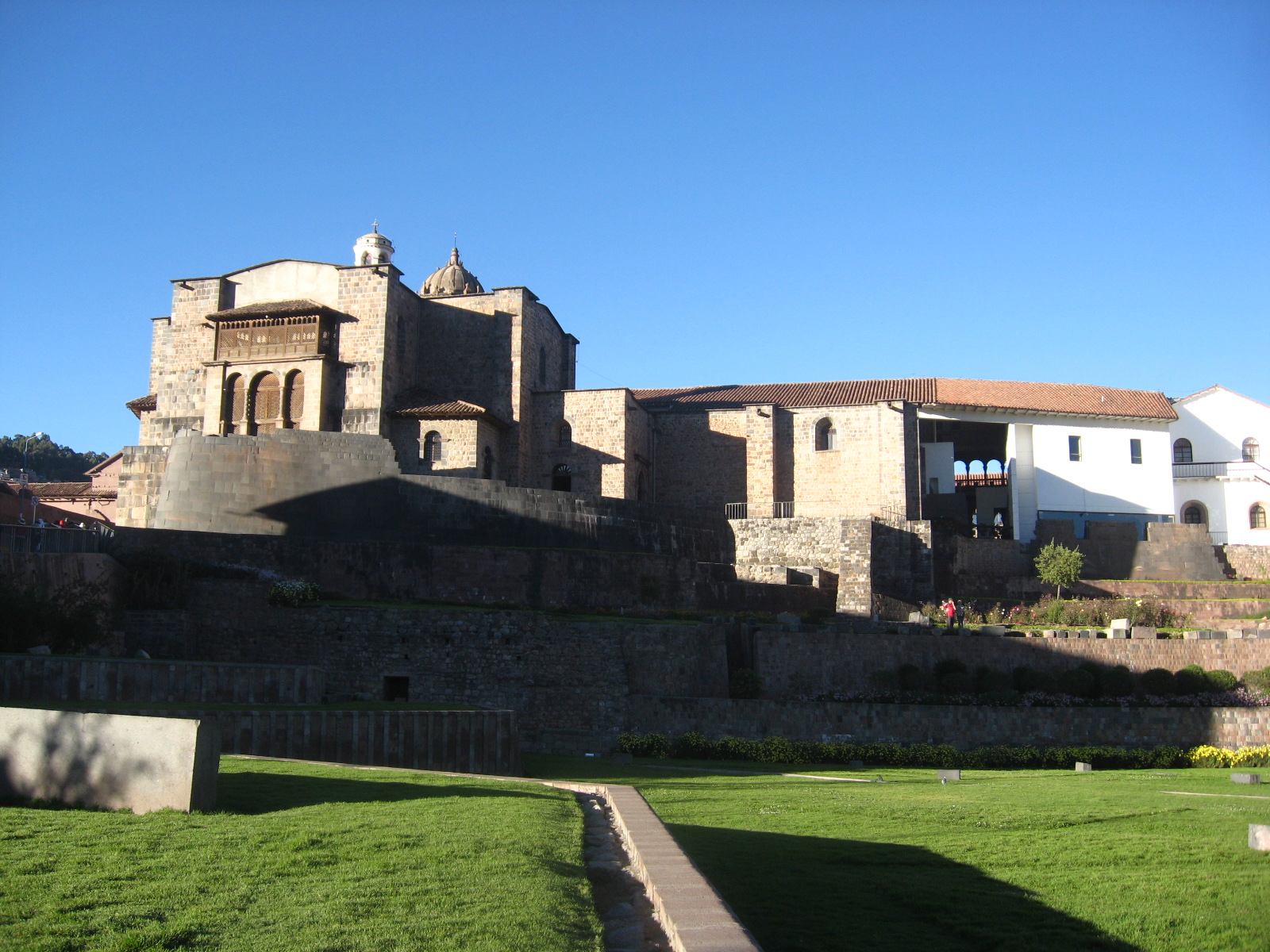
Qoricancha, the ruins of the Inca Temple of the Sun, one of the holiest sites in Cusco, Peru

10 Things I don’t like about Peru.

Since I’m going to ICPNA at 7:00 in the morning I typically see a few homeless people in the Plaza Tupac Amaru. Being that top 10 lists are all the rage, my daily walk to ICPNA inspired me to make my very own list of 10 things I don’t like about Peru (in no particular order):

10) Homeless people. Poverty in Cusco is not bad by Latin American standards, but we could still do better. I teach kids who have nicer cellphones, MP3 players and clothes than I have, so perhaps it’s a problem of priorities, not resources.
9) Papel hygenico. That is, toilet paper. Try finding it in Peruvian restrooms…
8) Stray dogs. I love dogs but hate to see so many of them run loose in the city.
7) Garbage. This is where the stray dogs and I disagree. The typical garbage pickup routine in Peru consists of throwing the garbage on the side of the street and then having a small army of city workers clean up 3 times per week. Please somebody start using garbage cans.
6) Bureacracy.

Update on Peruvian bureaucracy: it took nearly 6 months after moving to Peru to get legally married and over a year to get my Carne de extranjeria.

5) Old fashioned corporate culture. Big titles, dress codes and all sorts of junk even IBM and GE did away with in the 1980s are still all the rage here in Peru.
4) Education. People study all kinds of things, but are not always encouraged to apply their knowledge. My best friend used to say “It’s not how smart you are, it’s what you do with it.” It took me years to realize just how true this is.
3) Italian food, or lack thereof.
2) Pizza. Can someone from New York please move down to Cusco???
1) Public transportation. Try fitting in a “combi” with 21 other people when you’re 6’2″!

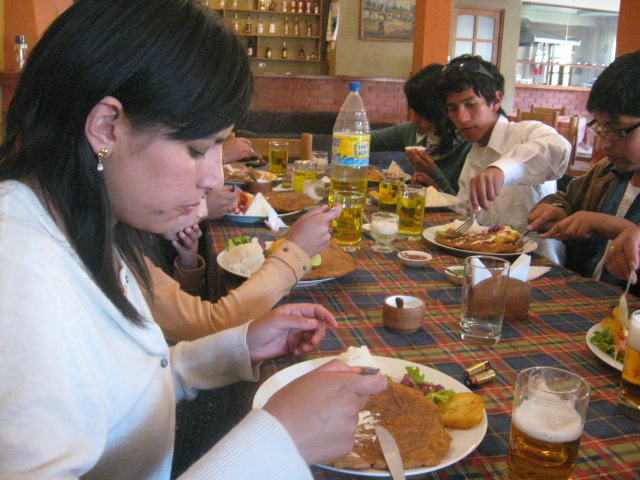
Typical Andean food.

Typical Andean food.

“La hoja de coca no es droga”

I recently read that Evo Morales, the populist president of Bolivia, is having some success at convincing farmers to grow other crops beside coca leaves. While Morales remains president of a powerful coca growers union, he is providing incentives for farmers to grow other crops as well to better deal with the recent increase in world food prices.

As I’m writing this I’m sipping a cup of “mate de coca”, green tea made of coca leaves. When I’m in the US often get asked about coca tea, since the coca leaf is also the base ingredient of cocaine. As the title of this post says: “The coca leaf is not a drug”, and there are no stimulating effects when you drink coca tea.

The coca leaf has historically had many uses here in the Andes region, it is practically worshiped for the natural healing qualities it is believed to hold. Native people chew the coca leaf, similar to chewing tobacco, and us gringos are offered coca tea when we first arrive to Cusco to help deal with the effects of the altitude. When I was ill earlier this year Tio Miguel (that’s Patricia’s uncle Miguel) gave us some healing lotions, which felt really good when I had pneumonia.

The US government has financed coca eradication programs from Columbia to Bolivia for decades, in an attempt to stop the flow of cocaine into the US. Since I moved to Peru I’ve become convinced those programs are akin to the Prime Minister of India coming down to Texas and telling the ranchers to stop raising cattle because it’s sacreligious.

The problems with the US programs are that they don’t recognize the value of the coca leaf here in the Andean cultures. In addition, they involve methods like spraying pesticide from airplanes. Not even my old pilot buddy Ralph Feather – who could barrel roll a loaded Convair 240 – is good enough to spray fields at night and not hit any people as well.

I wouldn’t pretend to have an easy solution to the drug problem, but it seems like Evo Morales is on to something not half bad in this case.

Ward Welvaert

Update: read about our trip to Bolivia.

"Evo SI" billboard in La Paz, Bolivia

'Evo SI' billboard in La Paz, Bolivia

Typical Peruvian countryside

Typical Peruvian countryside

I have a feeling we’re not in Peru any more…

I flew back to the US for a few weeks on July 2nd.  To maintain my US residency I have to visit regularly and keep real ties to the US, such as keeping my driver’s license current, filing tax returns, etc.  I also wanted to check up on our house in Youngsville (NC) and visit with some friends.

I spent July 4th with friends in Conway, SC.  I’ve known my friend Dennis and his family for over 15 years, since I went to aviation school in Conway back in 1993.   For July 4th we had a great party on the ‘island’ in the back of Dennis’ farm, complete with food, drinks, fireworks and a lot of fun.  After that I headed to NC and I’ll be flying back to Peru on July 17.

Ward

Feria de Huancaro


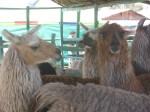
The annual fair in Huancaro started Thursday so we went for a visit this weekend. The Huancaro fair is one of the biggest fairs in the Cusco area, something of the equivalent of a state fair in the US. Like any fair here in Peru there is a variety of things to do and see. We watched some of the Alpaca contests, toured the stands at the fair and ate some Chicharron de Soya, a kind of soy chip which is a popular snack at the fair in Cusco. Not quite as greasy as deep fried Snickers, but then again, this ain’t the deep South either…

I think fairs and markets still have more economic significance compared to in the US. Here in Peru the fair is still an important opportunity for producers to show and sell their products, as well as an event for families to enjoy. Anyway, here are some pictures of Patricia and I at the Huancaro fair.

Ward Welvaert