We took a trip to the Raqchi archaeological site a while back. The site is about a 2 hour drive from Cusco, tour buses which take you on an excursion from Cusco to Lake Titicaca or Arequipa sometimes stop in Raqchi but overall it’s a pretty quiet site. Much of the ruins appear to be reconstructed but I like going to places like this because it gives you a glimpse of what life in the Inca empire could have been like. By the way, a good part of what you see in Machu Picchu today is also restored, as you can tell by the pictures from the Hiram Bingham expedition.
Tag Archives: Peru
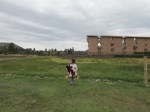


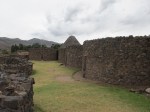

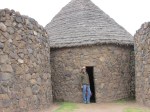


Paucartambo
Mamacita Linda went to work in Paucartambo for a couple of weeks recently. Unfortunately I didn’t get the opportunity to join her because I had baby-sitting duty at home. Mamacita says Paucartambo is very nice, quiet, clean, the kind of place where I would live if Mamacita let me. Unfortunately that won’t ever happen because schools in those small towns in Peru aren’t very good at all.
Paucartambo is located near the East edge of the Andes mountains, very close to the Amazon jungle. If you ever have the chance, make a trip from the Andes mountains to the jungle below, it’s one of the most stunning changes in environment you can ever make in a short period of time. Where the Andes meets the jungle is a beautiful place but also a place of significant environmental and social challenges nowadays.
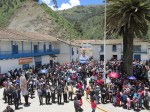
Paucartambo is known for its annual festival of the Virgen del Carmen which takes place in mid July. However, while Mamacita Linda was there, a procession took place in honor of the 30th anniversary of Pope John Paul visiting Paucartambo. Here are some pictures of Paucartambo and the procession:






Totally unrelated. I was thinking the other day, the farmhouse my dad grew up in didn’t have central heat (and it gets cold in Oostakker). Nowadays my dog sleeps on an orthopedic bed. I know it’s apples and oranges but the point is we have come a long way, I want to be thankful more often and fuss less than I do.
Maintenance

Coney Park
Happy New Year! I hope you enjoyed the holiday season and here’s to good health and good fortune in 2015.
Speaking of holidays, school is out for summer in Peru so both kids are home 24/7 and it’s a bit of a challenge to entertain them as it is also rainseason here in Cusco. Have I told you yet what an adventure it is to take our kids out on the town? Whoever coined the phrase “terrible 2” knew what they were talking about. Yesterday we took the kids to the movies, the one and only movie theater in Cusco is at a new-ish mall near our house. After the movie we were leaving the mall through the big ProMart home improvement store when we caught our youngest trying to flush her leftover popcorn down the toilet in one of ProMart’s exhibition bathrooms.
A while back I took both kids to that same mall by myself. I wanted to prove a point to Mamacita Linda: not only could I take both kids by myself, I could even accomplish something useful while I’m out and about with them, in this case buy a new pair of sneakers. I let the kids play for a bit in the Coney Park playground at the mall and then went sneaker shopping. In the shoestore my oldest all of a sudden realizes they are missing a toy phone they brought with them to the mall (which was a bad idea in the first place). We run back to Coney Park without any real hopes of finding the toy but to my surprise it was laying untouched by one of the games we played earlier. A friend of mine once left his wallet in a taxi in Dubai and the taxi driver returned to the hotel 20 mins later to give him back his wallet, insisting my friend check the contents to make sure nothing was missing. Here in Peru it’s rare to find something after you leave or forget it somewhere.
But I was going to tell you about maintenance. Before the lost phone incident, my kids were playing in a helicopter ride/toy at Coney Park. I was a bit suspicious because a few days prior I’d seen the helicopter tagged “out of service” but the tag was no longer there so I figured it had been fixed. The kids got in the helicopter but about halfway through it’s up-down left-right cycle, the machine seemed to get stuck and started shaking violently left to right, tossing my kids around as if they were limes in Jimmy Buffett’s blender. I yanked the power chord out of the wall and with a crying kid in each arm I advised the Coney Park staff their helicopter was broke, whoever “fixed it” didn’t get to the root of the problem.
This was before the lost phone. When we came back to Coney Park 15 minutes later looking for our toy phone, the manager was standing by the helicopter, watching another batch of kids go up and down, left and right. The machine worked OK for the moment so apparently it was considered “fixed”.
A broken toy is a minor inconvenience but in bigger issues like infrastructure the same attitude seems baked into the culture of Peru: don’t fix it as long as it kind of sort of works most of the time.
Pro-Tip: Gringo dudes getting married in Peru
So you’re standing in front of a church half-full of people you barely know, waiting for your sweetie to walk down the aisle. Your sweetie doesn’t show up and you recognize only a few of your sweetie’s family members – most of the ones you know aren’t there. Then the priest enters and starts his Mass, which you barely understand due to your limited Spanish. People are kneeling and praying and you generally have no clue what’s going on except that everyone is mostly ignoring you and your sweetie isn’t there.
Pro-Tip: THIS IS NORMAL!
You see, the only things that generally run on time in Peru are the Catholic Church and an occasional airline flight. The priest probably has 3 or 4 weddings scheduled on that beautiful day and if he were to wait for the bride, the last wedding would be 3 hours late. Just sit tight and about 2/3 through the mass, the church now full instead of half-full, your sweetie will show up, the priest will stop what he’s doing and your sweetie will walk down the aisle. Then everything goes on but at least you now have your sweetie who can translate for you.
whew.
* * *
We were invited to a friend’s wedding last week at the “Sistene Chapel of South America”, a small church about an hour outside of Cuzco with ceilings painted in the style of the Sistene Chapel. I’m a bad picture-taker but it’s absolutely beautiful. If you’re visiting Cuzco, don’t miss it.

Church of San Pedro de Andahuaylillas, known as the Sistene Chapel of South America
2014 Peru Election storylines
Yesterday Peru went to the polls and elected a new crop of regional and municipal leaders. There are plenty of story lines out there if you’re into that kind of thing. Just look for #MadeleineOsterling or #CastanedaLossio, read about the influence of cocaine cash or the soap opera around Gregorio Santos. One of the more interesting story lines is how practically none of the elected local and regional candidates have any affiliation with the supposedly “national” parties in Lima, in other words, central government is extremely weak.
Rather than talk about politics on a grand scale, you know I prefer the personal side of things, so I’ll share a personal election story.
Last week Mamacita Linda was late coming home from her job. She’s been working in a town about an hour outside of Cusco. Upon leaving her job, Mamacita Linda and her coworkers couldn’t immediately get to their driver because 2 political candidates were having their “closing rally” and the streets were packed. Eventually a large group of moto-taxis with flags for one of the political candidates passed by. Mamacita Linda and her friends waived down one of the moto-taxis and asked if he’d give them a ride to the terminal where their driver was waiting. The moto-taxi said he couldn’t, that he was participating in the political rally.
Always the economist, Mamacita Linda asked: “Wouldn’t you rather make a few $ than to participate in this rally?”
To which the moto-taxi driver replied: “I have to participate in the rally. This candidate paid for each of us a tank of gas so we are supporting him.”
There you have it. People gave their lives for the right to vote. Nowadays in Peru, your vote is worth about 2 gallons of gas.
Double Espresso
If you don’t have everything you want in life, ask yourself, how many friends do you have at the grocery store? This isn’t my original idea and making a friend or two at the grocery store won’t make you rich and famous overnight but most anything we want to achieve in life starts with breaking the ice and obtaining the trust of a perfect stranger. Need a new job, looking for a relationship, trying to get your business plan funded? Chances are, it involves making friends or acquaintances with perfect strangers.
All this to say a couple of years ago we had a baby-sit during the summer whom I met through her older sister, a checkout girl at our local grocery store. They were from a rural town (Sicuani) and the older sister worked 60+ hour weeks (10am to nearly 11pm 6 days a week) for a salary of less than $300 / month, to make a little money for her family and save up for school. This is not unusual in Peru, workers feel like they have no better choice and very often maybe they don’t.
Tomorrow regional and municipal elections are held here in Peru. Frank Bajak wrote a good article about how Cocaine cash is polluting Peruvian politics. There practically aren’t any ideologies or party lines in Peruvian politics any more, it’s just a rush to get in and steal.
“Politics has lost all ethical sense. Now, it’s just about being a pickpocket”
I often wonder, what if the middle class would have the self-confidence to demand better, to stand up to their corrupt and incompetent leaders. By and large, it seems as if the working class and middle class suffers from a sort of misplaced desperation, instead of demanding better they’re just dying to “get in” with the local elected leaders and get a piece of the pie. As if they don’t believe they can do better without resorting to the established way of corruption and incompetence. I often think it’s about self-confidence, all the way back to the kids education: the so-called “good schools” here don’t encourage critical thinking or standing up for yourself but they are very strong about falling in line, discipline and rote memorization.
One day when Anna, our old babysit, was getting ready to go back to school in her town I was at the Plaza de Armas and decided to have a cup of coffee with her. A new Starbucks had just opened up. We went inside and I said to Anna, one day you’re going to walk in here with all of your friends, and they’re going to be all nervous-nellie, staring at their feet because they feel out of place here, fumbling around because they won’t know what they want. They’ll be looking up at all these gringos and city-slickers ordering Frappuccinos as if those people are really somebody.
And I told her: “Don’t you dare to act like that. Hold your head up and look everybody in the eyes. Walk straight up to the counter and order a double espresso.
She replied: “I don’t even know what that is.”
I said don’t worry about that, I’m sure you’ll like it. Then we walked up to the counter and ordered 2 double espressos. Anna was only 14 and I don’t know if she understood what I was trying to tell her. I told her to never look down because of where she was from. When in doubt, hold your head up straight and order a double espresso. Let people know you don’t take stuff from anybody.
* * *

Just a pretty picture of my baby goose.
A bit more on corruption in Peru
Yesterday this article popped up on my Twitter feed. Other than the headline number of $3.5B in estimated annual corruption, the part about corruption in regional governments is eye-opening:
“…corruption in Peru’s regional governments have been in the spotlight with a number of regional presidents detained over accusations that they misused and profited from public funds … currently 22 of the 25 regional presidents are being investigated over allegations of corruption.”
Talk of corruption in Peru always reminds me of a conversation I had with a Peruvian friend of mine in the US, just before I left my job at GE to spend more time in Peru. My friend lives in the US but his father lives in Lima. Since we were both in aviation and my friend’s father was an officer in the Fuerza Aérea del Perú (FAP or Peruvian Air Force), my friend arranged for some introductions for me with aviation businesses in Lima.
One day before leaving my job in the US my friend and I had a conversation about bureaucracy in Peru and my friend insisted if I needed anything, to call on his father, his father had a good network and knew how to navigate the bureaucracy. Then my friend thought about this and said if I ever really needed any help, if I had any problems with the bureaucracy, that an even better solution would be if I called on his grandmother because she knew exactly how to “play the system” and waive a dollar bill at the right place and the right time. My friend said the idea wasn’t to waive a lot of money, just a dollar bill at the right time. In fact, he was convinced his grandmother would be able to get more done than his father.
This struck a chord with me because my friend’s father was a high ranking, well-respected officer in the FAP. He answered directly to the Minister of Defense. How could it be that a person waiving a dollar bill in the face of a bureaucrat can get more accomplished than an officer 2 levels down from the President of the Republic?
Sadly, my friend might have been right.
Make the bed you lie in
I’m late to this but there was a poll a while back that showed 41% of Limeños would vote for a candidate they know robs public funds, as long as their candidate does “obras” (public works).
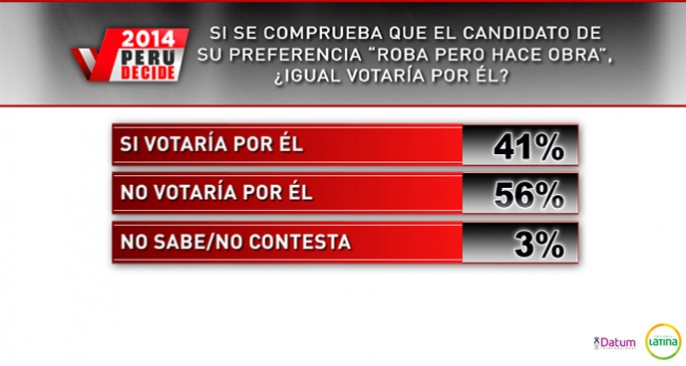
(Datum via Frequencia Latina)
This is in the context of the upcoming municipal and regional elections in Peru. I don’t follow Lima politics much but I believe the current mayor in Lima @SusanaVillaran has focused on organizational reforms (most visibly public transportation reform which is badly needed) and public opinion is that she doesn’t do enough brick-and-mortar public works.
It’s somewhat understandable that a person living in the poor “Pueblos Jovenes” cares about nothing more than getting running water and sewer but I’m sure the 41% also includes smartphone toting professionals and university students who should know better.
Corruption with impunity is endemic at all levels of leadership in Peru. Mamacita linda has been auditing local municipalities on behalf of the national “Controlaria” (a governmental audit agency) and their findings are horrible. At one small municipality, there was a payment of S/.15,000 (~US$4,500) for “expenses” to a close aide to the mayor. There are no receipts, no indication what the “expenses” were or how they were related to official business. Nothing. To put that in perspective, teachers probably make less than S/.2,000 per month in this town.
When the auditors finish their report, the national Controlaria will review the report and send it to the Fiscalia (Justice Department) where it will die. 6 months down the line a small blurb will be published in a legal register somewhere that the auditors’ report is invalid because the lead auditor only signed 126 instead of the full 128 pages as required by law nr 23456.45(b)(ii)(j) para 65.34.9 and there it ends.
* * *
Yesterday Ollanta Humala swore in a new Finance/Economy Minister here in Peru. You can view the details of the transition at IKN. Mamacita linda said something this morning about “not sure what will happen next” with the Peruvian economy and I opined that it wouldn’t make a bit of difference.
On her way to work Mamacita linda yelled out the door “I don’t know, some economists are kinda crazy sometimes!”
Washington Post on Peru’s crackdown against illegal mining
Not a bad article and pictures at the Washington Post. Here’s the article and a quick excerpt:
“After years of ignoring the frantic gold rush fouling the Amazon forests of southeastern Peru’s Madre de Dios region, the government has launched a no-mercy campaign to crush it.”
Otto has lamented the environmental damage done by illegal mining in Peru for years. It remains to be seen if Peru’s weak institutions and government will persevere in this crackdown.
One small thing you can do is not buy any gold or silver when you visit Peru. The jewelry stores here won’t be able to show procedence of gold, they’ll just lie or make something up. View my Twitter conversation with Otto about my dilemma in having to buy rings for a friend’s upcoming wedding.
Peru – country of almost
Happy birthday Milagros! Twenty-something years ago today, my Peruvian sister-in-law was born in the back seat of a taxi here in Cusco. True story. Mother and baby are fine – in case you were worried. Anytime my mother-in-law tells the story of how her youngest daughter was born in a taxi, the most entertaining part to me is that she always insists that “we were ALMOST to the hospital”.
As the saying goes, “Almost” only counts in horse shoes.
Here in Peru one thing that I find frustrating is that people tend to accept things that are “almost” right, “almost” finished, “almost” useable, etc. People put a lot of effort into something but stop short of finishing or doing it right. And they’re happy with it.
We live a privileged life and I don’t want to sound fussy, but sometimes a small discrepancy makes a big difference.
Would you eat a piece of chicken if it was almost cooked?
Would you get on a flight to Hawaii if the plane had almost enough fuel to get there?
Of course you wouldn’t.
In Peru people do accept things that are “almost good enough”. For example, we are supposed to be in the middle of a construction boom. Real estate prices have skyrocketed and there are new buildings going up everywhere. Most new buildings leave the sides unfinished, sloppy looking bricks between concrete columns. Looks very redneck. A (comparatively) small effort to finish and paint the sides would make a big difference.
That holds true in more important things as well, such as education. The public schools in Peru have classes of 50 kids or more. If you think about the combined effort of kids, parents, teachers and administrators that goes into someone’s education, hiring some more teachers and building some more classrooms isn’t a huge additional effort. In fact, for society as a whole it would be a trivial burden but the difference in the quality of education would be huge, if the kids sat in a class of 25 or 30 instead of a class of 50.
The same could be said for other important aspects of life in Peru, such public transportation, occupational safety, environmental protection, etc. The quality or results don’t reflect the effort or investment, in part because the society accepts “almost” as good enough.

Beautiful sunset in Huanchaco. We just returned from a short vacation at the beach.
 Life in Peru