Corporate workshop

I will be in the US during April – May. I just finished up a 2-day corporate workshop that I’ll be offering while I’m in the US.

The idea of this workshop will be to challenge participants to erase the destructive corporate culture of the late 20th century and replace it with new, responsible thinking. Any inquiries or referrals, please contact me.

Ward Welvaert
ward DOT welvaert AT gmail DOT com
919 889 9208

AIG bailout politics

The political posturing around the AIG bailout back home in the US almost makes Peruvian politicians look sincere…

Remember when former NY Attorney General Elliot Spitzer – not exactly the poster boy for ethics himself – keelhauled then-CEO Maurice “Hank” Greenberg in 2005? Here’s what Greenberg recently said about credit default swaps at AIG:

“However, he said AIG’s sales of credit default swaps “exploded” after he left the company in March 2005. He said AIGFP reportedly wrote as many credit default swaps in the nine months after he left than it did during the previous seven years combined and, he maintained, too much of its new business was tied to the subprime market.”

Instead of all the posturing, let AIG fail. It was just a house of cards. AIG’s business model of insuring investments only created a false illusion of security. Letting AIG fail would be a good first step to cleaning up both the financial system and ethics in business.

Bailouts and political posturing don’t change the fact that money is just a funny printed paper. Real productivity, what we contribute to society in tangible terms, and the tangible things you expect to get in return, is what matters. Just printing up more money so old guys in suits can continue to get ridiculously rich doesn’t seem like the solution to me.

The worst workshop ever

I’ve sat through my share of corporate workshops and training, in the US as well as here in Peru. Some I found valuable, others less so, but at the school where I teach we had a workshop this weekend that took the cake in a bad, bad way.

It was long – 8 hours with no more than 1 hour of interaction, the remaining 7 hours you sat and listened. It was in Spanish – knowing full well there were several gringos in the audience (including me) whose Spanish ranges from mediocre to non-existent. It was boring – by the end of the day even the Directors of the school looked exasperated. No schedule – There’s never a schedule for our academic meetings, you just sit and wait for whatever comes next.

A friend of mine said “It’s like a D-version of Dr. Phil.”

It was offensive and demeaning. The parts I did understand were about psycho-analyzing yourself, but in a very “in-your-face, you’re life is all bad, let me tell you how to live” kind of way. The facilitator yelled at grown adults like they were kindergartners.

To top it all of this workshop was held at the Royal Inca Hotel in Pisaq, an absolutely beautiful place with outdoor recreation facilities and a spa. The weather was beautiful… yet we spent the better part of the day inside listening to a condescending fool.

I usually skip the mandatory -yet unpaid – monthly academic meetings, but I thought I’d sign up for this one since it was supposed to be a fun weekend to get to know each other. The only fun part was when we took a break after lunch to check out the pool, although swimming an olympic size pool after drinking rum and coke was a bit tricky. That’s how bad it was… I resorted to drinking hard liquor in the middle of the day.

And this is going to help me how?

And this is going to help me how?

Even the Directors on the far end look bored

Even the Directors on the far end look bored

Unfortunately I don’t deal well with situations such as these, and I said some choice words as the day went on. I didn’t want to play the gringo card and leave, because I’m getting really disappointed at how our Peruvian teachers are treated, they don’t enjoy the same liberties us gringos do. Even though the school receives US taxpayer money, I would bet no US lawmaker would want their son or daughter to be treated like a Peruvian teacher here.

The plan was to stay overnight and “have fun” the next day, but I decided to skip out and head back to Cusco at night. I might have said things I would regret if I had stuck around to get drunk with the rest of the teachers and the Directors.

Message to Jeff Immelt:

Jeff,

There’s no real easy way to say this: please quit screwing my friends!!!

I’m sorry. This blog was previously free of profanity.

But Jeff, sometimes it’s better to say what you really think, and I honestly feel bad for my ex-collegues at GE who saved up for their retirement in GE stock. I got sentimental once and bought about $1,200 worth of GE stock for my 401(k), it’s probably worth $200 now. Some of my friends had their entire life savings in company stock, now they’ll be saying “hello, welcome to Wal-mart” for the next 20 years.

What really makes me angry Jeff, is that I remember seeing a memo from you several years ago saying “we still do too many things by the rules of some old playbook.” So I think you knew long ago the culture you inherited from the GE of Jack Welch was nothing but a grand illusion, but why didn’t you do anything about it?

Jeff, ayude me pues, GE’s Short/Current Long Term Debt alone is $193 billion, that’s 6 times the entire foreign debt of Peru, a country of 29 million people.

But let’s put things in perspective Jeff. Fly down here to Cusco (economy ticket on LAN is $800) and I’ll introduce you to a 10 year old kid in my English class. He has no hands but is happy as anything, he gets by just fine despite his disability. I can also introduce you to about 4,000 other kids where I teach, every one of them believes tomorrow will be better than today, and so do I.

I’ll also introduce you to Mama Vicky, who worked the land with her own two hands her entire life. Funny thing Jeff, Mama Vicky might “be worth” more than all of GE right now, since she has a house in a good area of Cusco – and no debt. But the point is this: she worked hard to provide tangible things to her family for eighty-some years, and GE can do the same thing.

GE makes lots of great things, tangible things, but GE culture is lousy. When I was at GE Jeff, kids with MBAs who didn’t know which pointy end of the airplane goes down the runway first had better career opportunities than hard working engineers and technicians. And what’s up with V-dollars? Come on Jeff, that sounds ridiculous even for a guy who went to business school.

I like how you cut the dividend Jeff, it was a decision based on reality. Quit worrying about AAA credit ratings. I know, I know, it affects the cost of capital. But borrowing money like it’s going out of style is what got us in this predicament, so let’s not borrow any more, okay Jeff.

Come have a few cervezas at Mama Africa with me and we can talk about how to ditch GE’s stale old 20th century culture and split of the industrial businesses in a successful IPO.

Seriously Jeff, you might think I’ve been drinking too much coca tea, but GE was a standard-bearer for business in the late 20th century, and that kind of culture is exactly what caused the recession. So let’s stop doing things like we did in the 20th century, that was a decade ago. Let’s look forward and start a radical overhaul of GE, so my friends can say “Welcome to Key West” or wherever they choose to retire, not “Welcome to Wal-mart” for the next 20 years.

21 reasons globalization as we know it is over

Here they are:

21 reasons globalization as we know it is over

21 reasons globalization as we know it is over

Front row: Glinish, Pamela, Jose Luis, … Back row: Luis, Milagros, Tania, … You get the idea. They were my students at ICPNA a few months ago.

I always ask them why they’re studying English, what their goals are.

Some examples: Pamela (the youngest one on the first row) is studying at UNSAAC to be an accountant, so is Tania (3rd. on the back row). Williams (2nd. from right on the back row) is a tour guide and Sharon (next to him) will probably be accepted in the performing arts program at the Católica in Lima. Jose Luis (front row) is studying medicine, his father is a doctor and dentist.

Not one of them ever told me they want to work a menial job in near slave-labor conditions for little money to support some fat cat CEO’s illusion of competitive advantage.

Some of the students at ICPNA may be privileged compared to the average Peruvian, but others proudly tell me they are the first generation in their families who have the opportunity to study and pursue a professional career. All of them are working hard to get a better life.

The old idea of globalization, selling natural resources to multinationals, outsourcing jobs for cheaper wages or moving factories to avoid environmental regulation is simply doomed – and that’s a good thing.

Old style globalization often did not add any tangible value, or improve the lives of the average Peruvian (or middle class America). Globalization 2.0 will be about real value, exchanging goods, ideas and services based on differences in geography, culture, infrastructure, economies of scale, etc.

I have ideas…

Even in the current downturn I’m very optimistic about the opportunities here in Peru, where the median age is 26 and the per capita GDP is $8,500. I have a ton of ideas: a floatplane business to visit Lake Titicaca, a web development company in Cusco, an export business of typical Andean products, … We’ll save the details for another day 🙂

Google speaks Quechua

A lot can be said about the success of Google, how the company largely took over the lucrative internet search business from one-time internet darling Yahoo!, and many of Google’s other success stories are the stuff college case studies are made of.

Here in Peru I noticed one more reason why Google became so successful: Google speaks Quechua.

Quechua is a native Indian language spoken here in the Andes region, it is believed to date back well before the Incas’ time. Today Quechua is an official language in Peru, it is spoken by the native Indian, typically rural, population in both Peru and Bolivia.

Of course lots of websites are available in different languages, that in itself is not the point. But think about this quote from Umair Haque’s Smart Growth Manifesto:

“Outcomes, not income. Dumb growth is about incomes – are we richer today than we were yesterday? Smart growth is about people, and how much better or worse off they are – not merely how much junk an economy can churn out.”

The significance of Google’s Quechua site is that I can’t imagine Google sees any substantial revenue from it.

I don’t say this to put down the Quechua language, but simply because most of the native population who speak Quechua also speak Spanish, and they revert from one language to the other seamlessly, with Spanish typically spoken in the cities and used in business.

Cost/benefit is an entirely different concept from revenue/cost. Even though Google may not see much revenue from its Quechua site, thanks to Google lots of schoolkids in little towns all over Peru can read and search information in their native language.

I believe it’s well past time to stop managing companies like we did during the era of supply-side economics in the 20th century. In the 21st century, businesses will find opportunity when they do things because it’s the right thing to do, when the outcome is something you would be proud of.

Kids in rural Peru whose native language is Quechua learn Spanish in school.

Kids in rural Peru whose native language is Quechua learn Spanish in school.

GE releases 4Q earnings

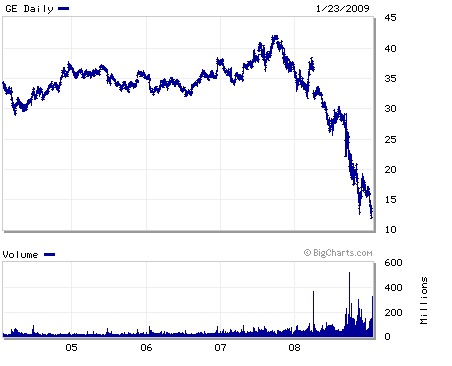
GE, my former employer, released earnings this morning. As expected, it wasn’t pretty.

GE needs a radical new corporate culture

GE needs a radical new corporate culture

Many of my former collegues who have been at GE since the stock’s heyday of the late 1990s have a hard time understanding how GE stock has consistently lost value for nearly 10 years now while the company continues to post profits. Some of them still believe the stock will go back up like it did in the 1990s.

Now working at GE was very good to me. The company has great benefits, health care, tuition reimbursement, a fixed pension, etc. In the aircraft engines division we had a fantastic team of engineers and technicians, as well as a world-class work environment. It’s easy to understand how many of my former collegues, from inside the company, always believed in GE’s stock.

The trouble with GE is that the finance arm Jack Welch created to buy and sell companies at will, and thereby achieve his illusion of “managed earnings”, has now become a big headache. I’m no finance guy or economist, but check out a great analysis of GE’s creaky balance sheet here.

What to do if I were Jeff Immelt:

GE’s corporate culture needs a radical overhaul. GE’s culture is still focused on things like competitive advantage, doing more with less, earnings growth, and all those tired old 20th century concepts that simply won’t work in the 21st century. Only by having a culture that relentlessly drove an illusion of value did GE end up with north of half a trillion $ in debt.

Change in a large organization is not easy, but here are some ideas:

  • Do away with all the “fast track” management programs (HRLP, OMLP, etc.) These programs are indeed good mentoring tools, but the trouble is they have created an exclusive fraternity. In a company with over 300,000 employees, it doesn’t make sense to largely limit your innovation and opportunities to a select club of “golden boys/girls”.
  • Get rid of most internal metrics and focus on managing people and relationships. Many metrics are unreliable and drive no behavior, or drive unwanted 20th century type thinking.
  • Ditch “Six Sigma”. I’m sure when “Six Sigma” was introduced as a quality tool it had its benefits, but it’s no longer relevant today. I could come up with many reasons why, for one, it stifles innovation, but most importantly “Six Sigma” is a throwback to the old way of doing things, pervasive like a cancer in GE’s culture, and it needs to go. Have a big “Green Book” bonfire. Bring hot dogs and hamburgers and have a “Six Sigma cookout” for employee morale. I’ll take onions and BBQ sauce on my burger please 😉

There are plenty of other things I could think of, but the main idea is that GE was a standard-bearer of business in the 20th century, yet corporate culture of the late 20th century set the stage for today’s crises, and a radical overhaul is needed. You can read Umair Haque’s great thoughts on 21st century economics and why 20th century thinking won’t work any more.

Reality check:

As much as I believe in overhauling corporate culture, GE may also have to make structural changes to survive. If GE were forced to take the kind of write-downs on its financial portfolio that major banks have (and there’s no reason why that’s not a possibility) the company would be in big trouble. It may be inevitable to split the finance arm from the rest of the company.

Some more positive ideas going forward:

  • Spin of the traditional (non-finance) businesses in a successful IPO. Why should all the good people and great technology in the traditional businesses be burdened with the worry about a half a trillion $ debt load?
  • Buy Yahoo! and combine it with GE’s traditional businesses. That’s right, GE’s technology and media businesses would be great partners for Yahoo! – a technology/media company. And coupled with a new and better corporate culture, it would be a cool new place to work!

In the final analysis, you may think I’m naive, just plain wrong or have been drinking too much coca tea. But GE and the rest of corporate America already know how to do business in the 20th century, so if I’m wrong we can always return to the old way of doing things. But if we wait any longer to look forward, it may be too late in case the new reality is here to stay, as I believe it is.

NB: 5 year chart used above courtesy of marketwatch.

21st century globalization – a perspective from Peru

With the start of the New Year there are lots of opinions and blog posts out there about how to deal with the global financial crisis and the economy today. I agree with Umair Haque that “… this year, those with the purpose, courage, and vision to get seriously radical will have the opportunity to reconceive and reinvent the global economy”.

What strikes me in all of the current discussion is how much corporate culture, and many of the solutions being proposed, continue to resemble the ideas and corporate culture of the 20th century – the same tired old ideas that caused the crisis in the first place.

One idea that needs to be revisited is globalization. The old way of globalization was to move labor-intensive work to developing economies to save costs and find less environmental restrictions, see the case of La Oroya here in Peru.

Here’s why and how globalization needs to be reinvented for the 21st century:

  • Relationships matter. Too often the old way of globalization was to “get the deal done” and then get the heck out of this backwards place. The economy is truly global today, the developing world expects to be treated as an equal partner, future growth will undoubtedly be in the developing world – it’s not too late to start building real relationships, but start now.
  • Contribute something. Just buying “cheap labor” is an unsustainable illusion, there has to be a balance, something of value added to the developing economies where you buy the labor. If not, the developing world ends up with a big pile of funny green printed paper and the developed world ends up with a ton of stuff we don’t need and a colossal credit crisis – newsflash: we’re there!
  • So what can the developed world contribute, how can you rebalance globalization? Let’s open-source globalization: share your know-how, human resources and intellectual property. The developing world still needs a lot of improvements, from occupational safety to environmental protections and employee development – things we are good at.
  • Forget about competitive advantage. My old bosses at GE would cringe… $30,000 on tuition reimbursement for business school and I dare say “forget about competitive advantage”? That’s right, globalization was all about gaining an advantage over organized labor, suppliers, etc. Problem is, for a sustainable enterprise you need a good workforce, reliable suppliers, distribution channels, etc. Trying to gain advantage over them is akin to destroying your own future.

There are a lot of opportunities in developing economies. Here in Peru, half of the population today is less than 26 years old and the country’s infrastructure is nowhere near ready for the economic growth that definitely will happen when these young people start their own lives and families.

In closing, consider the developing economies an equal partner. If you’re doing business overseas, you can contribute your ideas and expertise to the corporate culture there, as well as learn from your foreign partners. Globalization today should be about businesses in mature economies benefiting from a solid presence in the developing world while at the same time helping to improve the quality of life there.

Ward Welvaert