How to bring a dictator to justice – or not?

My good friends at CIP are participating in a presentation on the successful extradition of Alberto Fujimori.

“The recent conviction and sentencing of former Peruvian president Alberto Fujimori have been widely applauded as a remarkable achievement in transitional justice. Thorough, transparent, and impartial, this historic trial marks the first instance of a national court bringing an elected head of state to justice. Much of the success of the trial proceedings relied on groundwork and actions initiated by the Ad Hoc Solicitor’s Office, established in 2000 by the Peruvian government to build criminal cases against Fujimori and his associates. In his role as Ad Hoc Solicitor, Mr. Antonio Maldonado capitalized on Fujimori’s ill-considered decision to travel to Chile in 2005 and led efforts to marshal evidence and extradite the former president. Critical to the success of the extradition was the use of the precedent-setting “autor mediato” (indirect-author) theory, a legal instrument which held Fujimori criminally liable for human rights violations committed by his network. In his presentation, Mr. Maldonado will explain the extradition process and examine the significance of this paradigmatic example of international cooperation in the pursuit of justice. His presentation will be followed by comments by Dr. Cynthia McClintock and Dr. Jo-Marie Burt and will be moderated by Dr. Diego Abente Brun.”

I don’t mean to be insensitive to anyone who suffered from abuses under the Fujimori regime, but I have to disagree with the folks at CIP on this:

The Fujimori verdict and the “autor-mediato” principle give everyone in Peru who was complicit in the abuses of his regime a way to escape responsibility, and that is bad for Peru.

After the bloodbath in Bagua last week, you have to ask how the country is any better now than a decade ago, and how can a government that kills its own citizens and manipulates the media possibly have any credibility bringing their predecessors to justice?

Look, I love Peru but I’m not naive, there are a lot of issues. I worry that saying “justice has been done”, now that Fujimori is in jail, puts a false stamp of approval on the Peru of today. But the problems in Peru don’t begin or end with Alberto Fujimori or even Alan Garcia, just changing the puppet master at the top without changing the culture only gives us a false sense of improvement and a convenient excuse to escape accountability.

I’ve seen nothing but apathy here in Cusco around the Fujimori verdict, perhaps because many people remember how Peru was before Fujimori.
Boleta de Pago – Peruvian paycheck

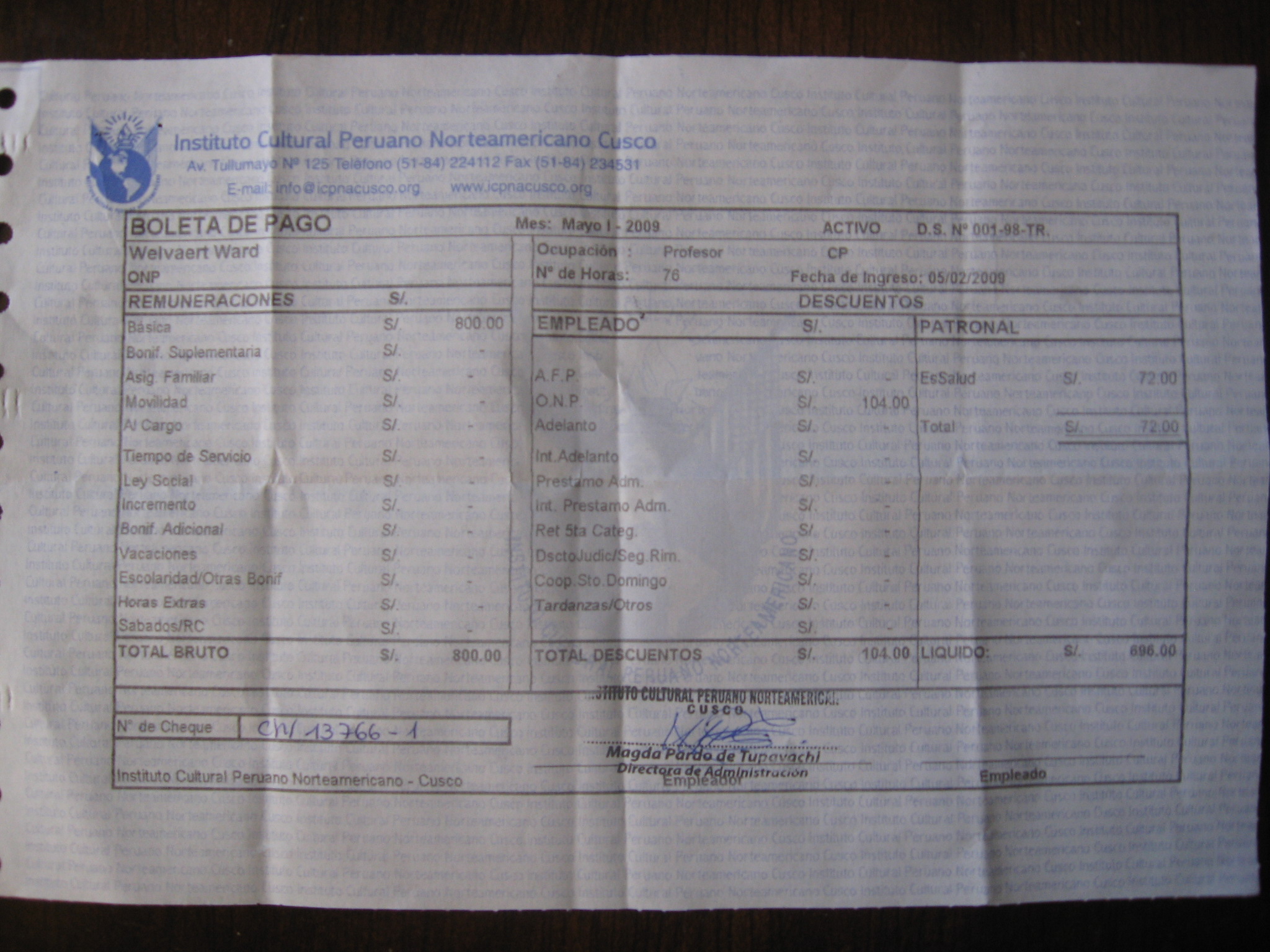
Here’s my paycheck for teaching ESL part-time for the month of May.

Boleta de pago

Boleta de pago

“Read ’em and weep boys” That’s what an instructor I used to know would say as he handed back his students’ graded exams. Same could be said for paychecks in Peru.

I only taught 2 classes, or about 4 hours a day, 18 days per month. The grand total is S/.800 (~ $280). Notice how S/.104 (~$35) is deducted for my retirement and my employer generously chips in S/.72 (~$25) for EsSalud health insurance. I take home S/.696 (~$250) at the end of the month.

That’s less than what the taxes on my WEEKLY paychecks at GE used to be 😦

Not that I’m an ungrateful gringo, I just do the teaching job for fun, it’s a nice way to meet local people and get out of the house for a few hours. For a single person who wants to spend a few months in Latin America teaching ESL is actually a good gig. If you work full time (4 classes ~ 8 hrs / day) you can make about S/. 1,500 (~$500) per month, enough to cover your living expenses down here.

At ICPNA my pay is actually better than average for Peru. The minimum wage in Peru is around S/.550 (~$180) per month, average starting wages in Cusco for respectable jobs like drivers, nurses or teachers are around S/.800 (~$280) per month – full time.

If you ask me, the way to make money in Peru, start your own business. That’s what I tell all my students, “Make your own luck, don’t work slave labor for a bunch of old rich guys…”

Clausurado

For comic relief – I need it after the Bagua disaster.

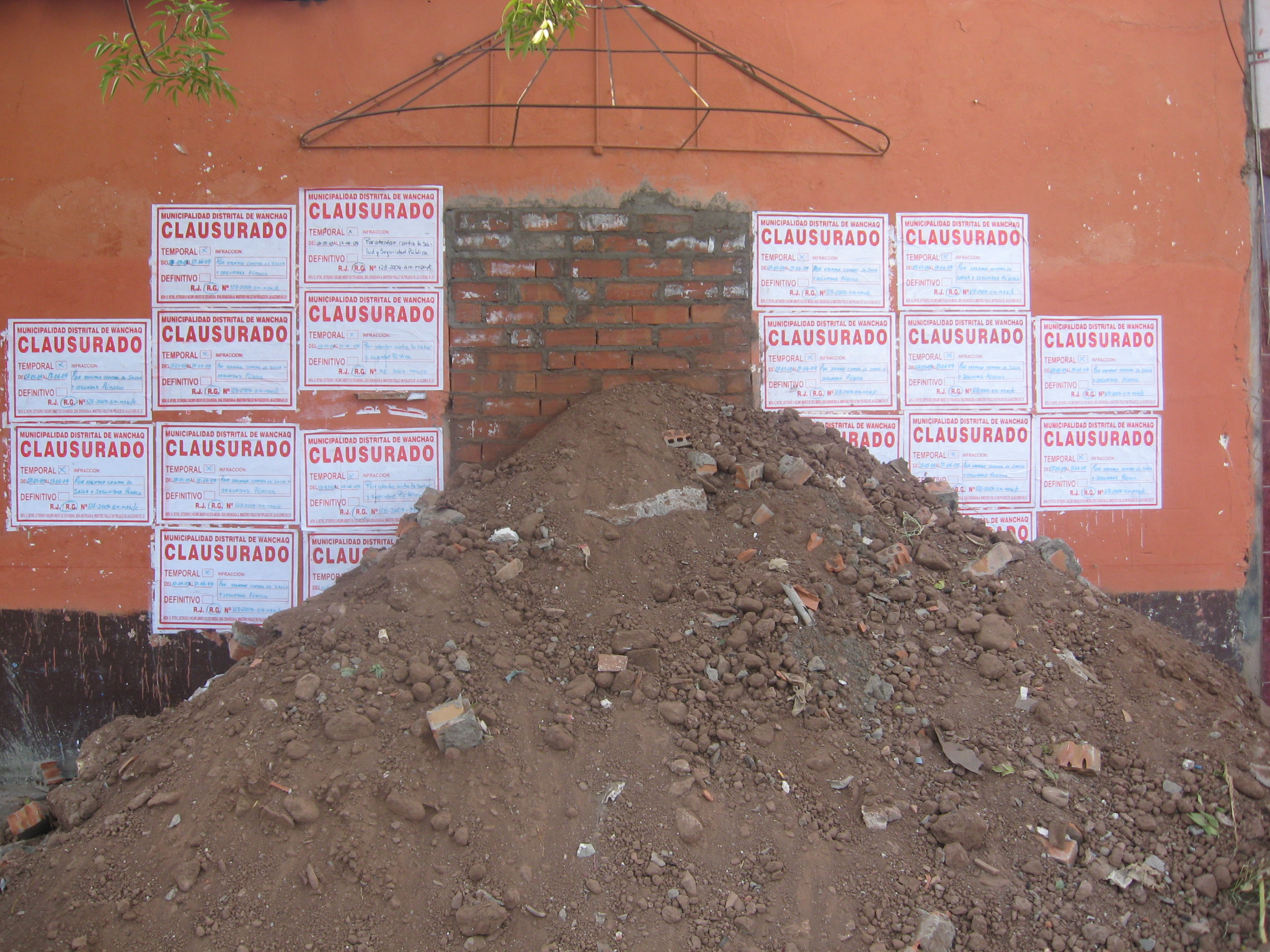
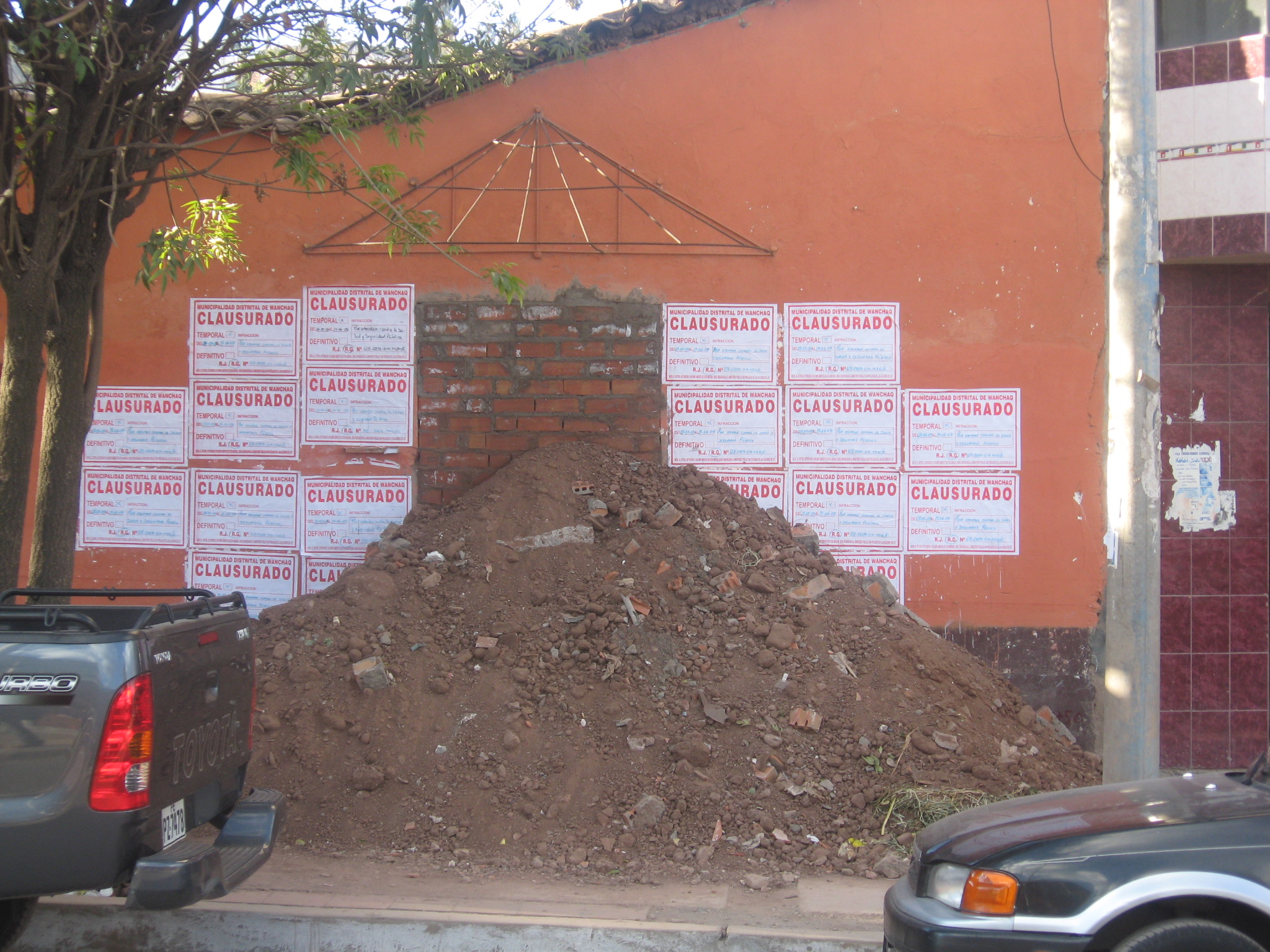
Here’s a place down the street that got temporarily closed down for “sanitary reasons” or “disturbing the peace”.

Clausurado

Clausurado

These guys don't mess around

These guys don't mess around

The brick wall behind the load of dirt is where the entrance is supposed to be. You see this kind of thing once in a while here in the regular neighborhoods in Cusco. Typically it’s a local watering hole that was too loud or unruly for its neighbors.

Bagua, Peru – what you can do

I’ve seen a number posts with ways you can express your voice about the bloodbath that happened yesterday in Bagua, in the Peruvian Amazon. Some good sites are Peruanista, Amazilia’s blog and IKN.

But frankly, the most effective action a US citizen can take is to write your elected representative and tell them no amount of free trade or money can ever be justification for bloodshed. Tell your reps that sections 16, 17 (labor) and 18 of the US-Peru Free Trade Agreement are nothing but pie-in-the-sky promises that have no validity outside the wealthy areas of Lima. The US ought to demand the FTA is frozen or revoked until the government of Peru gets a dose of social equity.

Because of what happened, and Alan Garcia’s comments, there can be no other alternative: Alan Garcia must resign. If this kind of bloodshed had taken place in Bolivia or Venezuela, there would be international condemnation all the way from the White House. The accepted belief in the US and Europe that the government of Alan Garcia (30% approval rating) is somehow better than that of Evo Morales or Hugo Chavez (60% approval ratings) is perhaps understandable due to ideologies, but nevertheless completely false.

The macro-economic gains that Peru has enjoyed have not translated to improved quality of life for people in the provinces. The deep-rooted divisions between ethnic groups have only been amplified as the wealthy in Lima sell out the country’s natural resources with little or no benefit for indigenous people. And finally, all the so-called economic gains are extremely short-sighted. If the world economy experiences significant inflation for a few years – which is entirely possible – the large sums of foreign investment Alan Garcia and his cronies now rave about will seem like a pittance. But by then it will be too late, Peru’s vast natural resources will have been sold out. Future generations will work for pennies-on-the-dollar to pay for today’s windfall for a bunch of rich old guys in suits.

There are many great opportunities in Peru, the idea that bloodshed and selling out 72% of the Peruvian Amazon is somehow justifiable or necessary for progress is deplorable.

Peru says 5 police killed in Amazon protest

Here’s the news about sad, needless loss of life in the ongoing dispute between the Peruvian government in Lima and the indigenous people in the Peruvian Amazon, who are trying to protect their lands from development. In English from AP and in Spanish from El Comercio.

Another needless tragedy in a country that has fantastic human and natural resources.

There’s no justification for violence, and blame on both sides. Check out IKN for more insight on the developments leading up to this.

If the global events of the last year or so prove anything, it’s to be leary of rich old guys in suits. The money-at-all costs Peruvian government of Alan Garcia and APRA need to realize money is just a funny printed paper, making money in Lima is fruitless if it doesn’t improve the lives of all Peruvians.

UPDATE:

There are now 7 police and 22 indigenous civilians reported killed in the unrest in Bagua, in the Peruvian Amazon.

Pictures and reports of reporters possibly also killed at La Republica.

Protest in Bagua, Peruvian Amazon

Protest in Bagua, Peruvian Amazon

More on the Bagua situation and how you can voice concern:

n89605273186_8300

As they say in Belgium “Trop is Te Veel, and Te Veel is Trop”. Time for Alan Garcia to resign.

GM turnaround plan

I’m worried that my brother – and many other good people – could lose their jobs in the GM bankruptcy (filing doc pdf). Now is not the time to point fingers or argue over the same stale disagreements that have existed for years, but a time to figure out how to make business better for the future.

The turnaround plans I’ve read in the media seem to consist mainly of wiping out shareholders (done), swapping debt for equity, and starting over. However, I haven’t seen much to address what I believe are structural problems at GM, such as:

  • Splitting the finance arm from manufacturing
  • Divesting the international divisions (Opel, Vauxhall, Saab)
  • The failed ideas of globalization
  • Improving labor relations (okay, they’re giving part of the company to the union to erase a debt, but what are they actually doing to improve morale & productivity of the workers, or to create a pipeline of talented engineers and skilled technicians?)

So I wrote a turnaround plan for GM, admittedly from outside looking in. Hopefully some of it will fall on the right ears in Detroit, Washington, New York or Germany. You can download my GM turnaround plan from hayleyinternational.com. Although I wrote the presentation with GM in mind, many of the ideas are also relevant to other struggling, 20th century businesses.

Download GM turnaround plan – Powerpointhtml

I was influenced by ideas from others, most notably Option Armageddon and Umair Haque. If I overlooked any credits in the presentation, please let me know. If you use any of the ideas in the presentation, please also be so kind as to give credit.

My presentation is certainly no silver bullet to the GM restructuring (there’s billions in bondholder obligations), so feel free to add ideas in the comments or contact me for discussion.

Ward Welvaert

Lucky

I’m so lucky in so many ways… love, career, family, travel, …

A silly stroke of luck again came my way last week. At ICPNA Cusco, where I teach English part time, the teachers are not supposed to wear jeans or sneakers. My boss has devoted ample time to this, but I keep flaunting that particular rule anyway.

The other day as I walked up to the main office my boss looked at me up and down, clearly not approving of my jeans and sneakers, when one of the academic coordinators sort of barged in among a bunch of teachers who were there and said…

“… Ward, I just have to tell you, one of my former students is now in your class and she just told me how happy the entire class is to have you, and what a great teacher you are…”

A few of the teachers and I sort of played it down “you sure they were talking about me?” but I know my boss took notice. Thank you Rosanna !!!!

ESL students and me, in jeans and sneakers

ESL students and me, in jeans and sneakers

Now I don’t wear jeans and sneakers to be difficult, but because:

  • At age 35 I’m now officially a middle age white guy and my old suits don’t fit very well any more 😦
  • I try to teach all my students to be rebels

Although I love Peru there are a lot of issues here, such as poverty, corruption, prejudice, environmental protections, protection of land for indigenous people, etc. I tell all my students to be rebels, stop accepting the status quo, if they want a better Peru they are the ones to make it better.

So I am a rebel, I try to lead by example, I wear jeans and sneakers to let my boss know there are more important issues to address than the kind of clothes people are wearing.

Thanks Rosanna, and thanks Silvana!!

Healthy breakfast

Quick: Name something everyone has but no one uses?

A juice extractor, of course.

Fresh fruits

Fresh fruits

Despite the fact it takes 45 minutes to make a jar of juice, and another 45 minutes to clean up the mess, we make fresh juice once in a while because the fresh fruit here in Cusco is to die for. The high Andes are known for typical crops such as Quinua and Kiwicha, purple corn, etc. But Cusco is close to lower-elevation areas such as Quillabamba and Limatambo where fruit grows readily.

We buy fresh apples, grapes, bananas, oranges and pineapple, just to name a few, at the market here in Wanchaq. We also eat fresh palta (avocado) at least once a week. Sometimes simply “pan con palta” for breakfast, or other times I make my (almost) world famous guacamole burgers.

Healthy breakfast

Healthy breakfast

I love how we can get practically everything fresh here. The one odd thing that I just can’t get over is how fresh bananas last several weeks, instead of 3 days in the US.

Peruvian food is excellent, even when prepared by a gringo 🙂

Goals and dreams – of a 12 year old

I gave my ESL students a writing exercise, write about “your goals and dreams”. This is from a 12 year old girl, unedited:

“When I was 6 years old my goals was be the president of Peru to change Peru, because Peru in the past was horrible and destroyed by other presidents…”

And a few other excerpts:

“Now I’m 12 years old… I plan to collect a lot of money to construct a big house … I plan to buy other house to give to my parents, because they did anything to me.”

Maybe I’m being sentimental because we’re getting ready to have our own baby soon, but I thought that was worth sharing.