Much has been written about the many great foods of Peru, but let me give you some insight in the process of cooking, how that great yummie food ends up on our table.
Now my experiences are not representative of all of Peru. There is a world of difference between the elite in Miraflores who have beautiful grocery stores, cooks and maids, and the rural population who live of the land and cook on a fogon. I can only speak from my own experiences living in a middle-class area of Cusco.
What you need to know in order to grasp the concept of cooking in our neighborhood, is that there are many small stores and very few larger stores in Cusco. In our complex, there must be 6 or 8 of these 1-man or 1-woman stores, like the one in the picture below. Each store is about the size of a big pantry and serves maybe 2 or 3 apartment blocks.
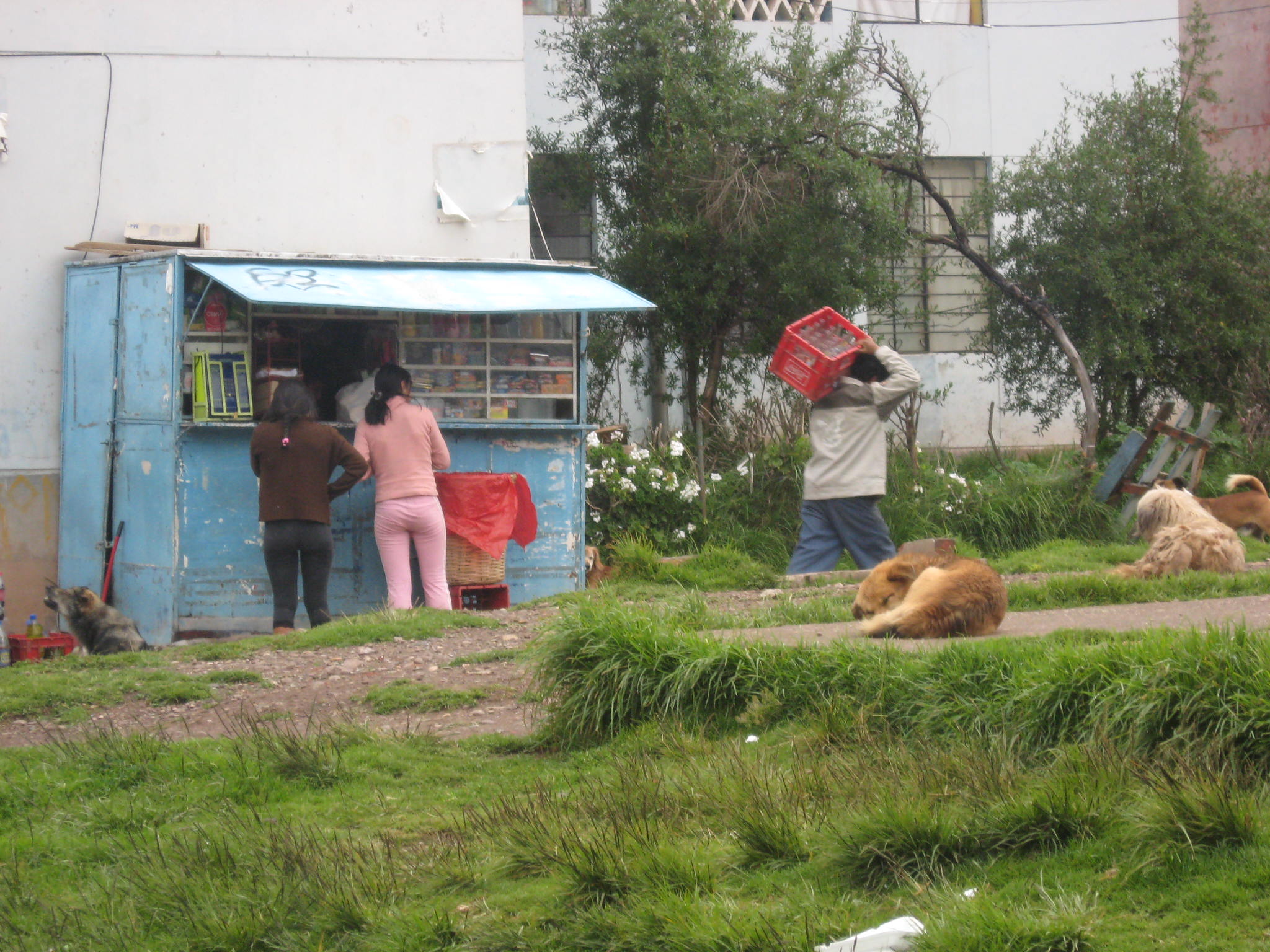
One of the little stores in our neighborhood
Just for contrast, a little bit of background about the process of cooking in the other cultures I’ve lived in:
Cooking in Belgium:
Belgian people are super-efficient, in an old-fashioned, hard-working, German kind of way. In addition, for many in the graying population, the Depression and World War 2 are only a generation away, so their comfort level is to stock up a ton of food in their pantries, freezers, etc.
In my house, this is how we used to cook:
(1) Dad peels potatos — God knows Belgians eat a lot of potatos.
(2) Mom gets meat and vegetables out of pantry / fridge / freezer.
(3) 20 minutes later everyone’s at the table eating and another 20 minutes later the dishes are done.
Cooking in the US:
In the US people do everything big, not just in Texas. Twice a week I used to stop at the grocery store on the way back from work and spend $100 or more on groceries. I’d eat as much red meat in a week as I do now in 2 months. Seriously.
(1) Drive home, fire up the grill.
(2) Open bag of salad and put baking potato in Microwave.
(3) 15 minutes later dinner is ready.
Cooking in Peru:
Let’s take a typical weekday, lunch is the big meal. The cooking is usually done by mamacita or my suegra.
12:15 – Hey, it’s time to start cooking.
12:17 – I’m going to Señora Maria’s store. (see above).
12:22 – At the store, there are three or four other ladies from the neighborhood. Everyone talks, and talks for a while.
12:47 – I’m back from the store. Time to cut the vegetables.
12:57 – Holy guacamole, you realize you forgot to buy onions.
12:59 – You go back to Señora Maria’s store only to find out it is now closed, Señora Maria is also cooking. No problem, you go to another “store” 200 yards away.
13:05 – The lady at the other store has the new Avon / Esika / L’Ebel / Leonisa or whatever catalogue, so you check it out.
13:24 – Walking back to the house with your 2 cebollas, you run into your friend from “collegio” and talk for awhile.
13:48 – Back at the house you chop up the vegetables and potatos and throw them into the trusty pressure cooker along with some noodles. Soup will be ready soon.
13:50 – Don’t forget the rice. I think Peruvians eat more rice than Belgians eat potatos.
14:02 – Time to set the table.
14:04 – Yell at your ayudante (in our case, my sister in law). Helen, Heeeleen, Heeeeleeen.
14:12 – Tell Helen to go to “the store” and buy something to drink. Helen and my suegra then argue about what kind of soda to buy and how much money to spend.
14:15 – Food for the wawa (baby) is ready. Papi feeds the wawa.
14:26 – Table is set, Helen came back with soda, soup is served.
14:35 – “Segundo” or the main course is served.
15:50 – Table is cleaned and dishes are done.
Until tomorrow, then we do it all over again 🙂



 Life in Peru