GM, Peru interest rates and 2-party communism

Random thoughts on some of the day’s main business news:

GM exits bankruptcy. CEO Fritz Henderson said

“…the new GM will be faster and more responsive to customers than the old one and it will make money and repay government loans faster than required.”

Yeah, right. Why don’t I have warm fuzzies about this? When was the last time a company majority owned by the US government and the UAW became faster and more responsive? The company even brought back Bob Lutz, one of the old rich guys who was at the helm of the ship when it went under. Sure GM dumped a bunch of liabilities, but with revolutionaries like the US government, the UAW and Bob Lutz in the driver’s seat I doubt they made a lot of structural changes to the problems that got them in trouble to begin with.

Perhaps the biggest thing I question about GM’s reorganization plan is the sale of Saturn, which essentially becomes an independent dealer network. If you’ve never heard of Chery, JAC, SsangYong or Mahindra, you may soon enough at a Saturn dealer near you. In 5 or 10 years, GM will be relegated to selling trucks, Suburbans and Corvettes, no mas.

New Chery cars at a Peruvian dealership

New Chery cars at a Peruvian dealership

In other news, Peru lowers interest rates. Interest rates are near zero practically all over the world. How’s that been working out for Japan in the last 2 decades or so? I’m with the camp that says the whole financial mess was caused by too much leverage, lending more money is not the solution.

By the way, since interest rates in the US are near zero, how much should you be paying on your credit cards? And if you’re paying 5% on your mortgage, isn’t that about 4.5% too much? Exactly where does that 4.5% go? Once again, if you believe the well-being of the big banks on Wall Street – at the taxpayers expense – is in the best interest of middle class America, I’ve got a mountain in Peru I’d love to sell you 😉

More news this simple mind doesn’t understand… Timmy Geithner says derivatives should be regulated. Creo que no. Regulation isn’t the answer. What would have been better is if the government had simply let AIG fail, this way most of the derivatives would have gone away and perhaps, just maybe, the bankers on Wall Street might have gotten a lesson in morality. Not to mention, taxpayers would have been saved some $180 billion that now went to such needy institutions as Goldman Sachs and Deutsche Bank. Let the market adjust itself, stop bailing out old rich guys in suits.

2-party communism

All this brings me to my main point, the US effectively is a 2-party communist state now. Sure you have individual freedoms, so I don’t mean to imply communism like in the old Soviet Union. But realistically, business and government have become institutionalized and joined at the hip. GM, Chrysler, untold number of banks have been deemed “too big too fail” and are without a doubt taking advantage of that status. Treasury and the Fed prefer regulation over allowing the markets to correct. Bernanke, Geithner, et al are printing up money to distribute as they see fit, practically reducing competitive advantage to where you stand in your ability to tap into government funds. In Washington and New York, decision makers move seemlessly between government and private positions. Henry Paulson was at Goldman before he came to Treasury, wanna take bets where Timmy Geithner will be in 2 years?

All this of course is bad for innovation and real value creation – ever driven an old Lada? Businesses that have become institutions of government have little incentive to make or do better things, yet they wield tremendous competitive advantage over independent companies.

I’m not too worried about any of this though. I believe you have to make your own luck, no matter what the big wigs in Washington, New York or Lima say or do. And the pendulum will eventually swing back in the opposite direction, as it always does. But for now we are “kicking the proverbial can down the road” too much, and future generations will be paying for our excesses. Better get ready to work, Brianna 🙂
La Oroya – DRP environmental report update

As a Fullbright scholar, Corey LaPlante studied the environmental impact of the La Oroya – Doe Run Peru (DRP) smelter over the past year or so. He published some summaries of his findings on his blog, including:

  • Research that shows contamination in La Oroya may actually have increased since Doe Run arrived in 1997.
  • Some regulatory background about Peru’s environmental management plan or PAMA. Excellent questions whether PAMA is really sufficient and whether Doe Run Peru has complied with its obligations.
  • Research on children’s blood-lead levels near La Oroya. Interesting finding how the improvements advocated by Doe Run correspond with testing further and further away from the smelter.

I think Corey did a great job studying the environmental impact as well as the social and economic drivers that keep enabling the situation at La Oroya. He kept his research free of inflammatory rhetoric or ideological influences which all too often skew the environmental debate.

Again, check out his findings here.

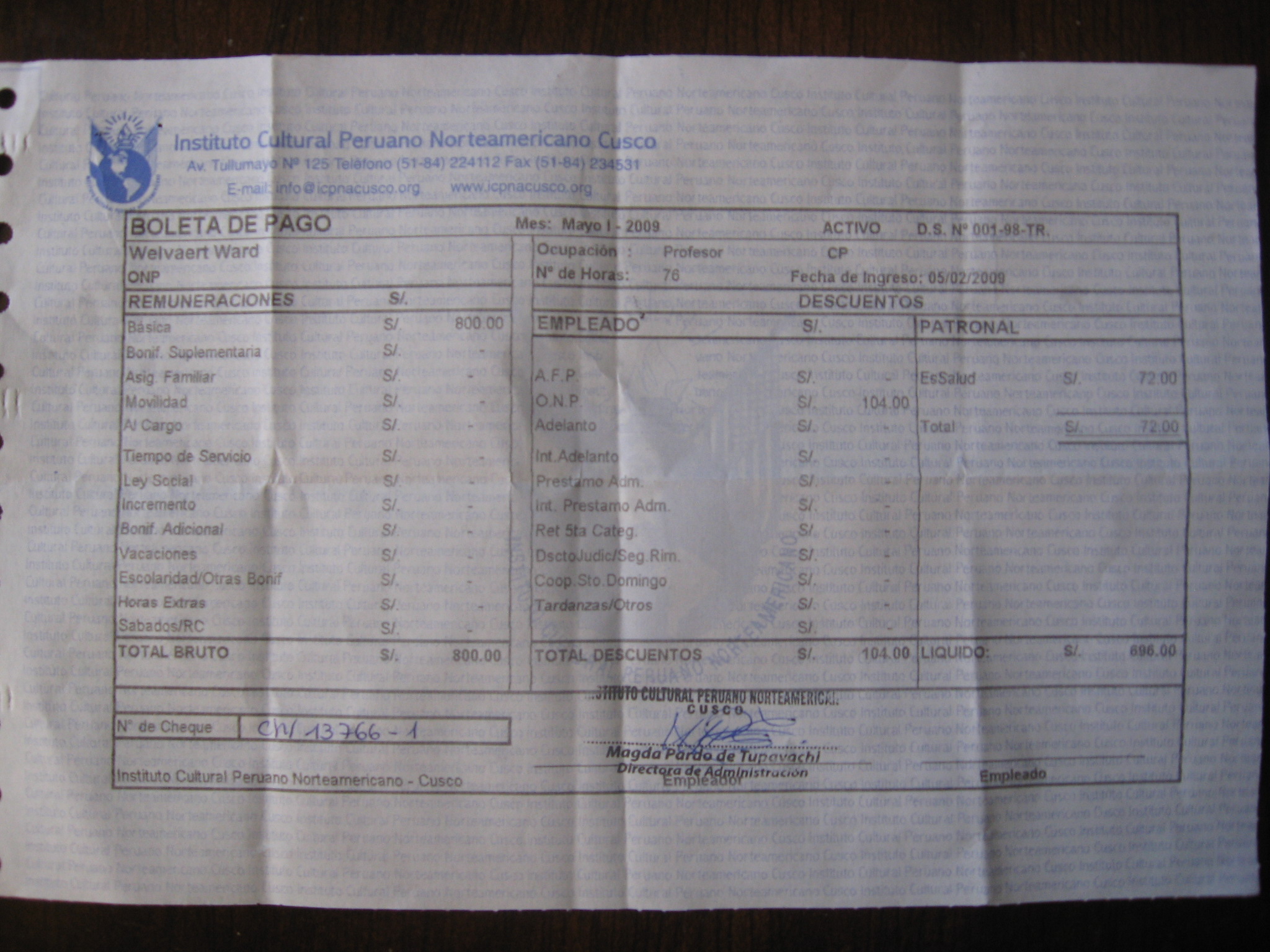
Boleta de Pago – Peruvian paycheck

Here’s my paycheck for teaching ESL part-time for the month of May.

Boleta de pago

Boleta de pago

“Read ’em and weep boys” That’s what an instructor I used to know would say as he handed back his students’ graded exams. Same could be said for paychecks in Peru.

I only taught 2 classes, or about 4 hours a day, 18 days per month. The grand total is S/.800 (~ $280). Notice how S/.104 (~$35) is deducted for my retirement and my employer generously chips in S/.72 (~$25) for EsSalud health insurance. I take home S/.696 (~$250) at the end of the month.

That’s less than what the taxes on my WEEKLY paychecks at GE used to be 😦

Not that I’m an ungrateful gringo, I just do the teaching job for fun, it’s a nice way to meet local people and get out of the house for a few hours. For a single person who wants to spend a few months in Latin America teaching ESL is actually a good gig. If you work full time (4 classes ~ 8 hrs / day) you can make about S/. 1,500 (~$500) per month, enough to cover your living expenses down here.

At ICPNA my pay is actually better than average for Peru. The minimum wage in Peru is around S/.550 (~$180) per month, average starting wages in Cusco for respectable jobs like drivers, nurses or teachers are around S/.800 (~$280) per month – full time.

If you ask me, the way to make money in Peru, start your own business. That’s what I tell all my students, “Make your own luck, don’t work slave labor for a bunch of old rich guys…”

Bagua, Peru – what you can do

I’ve seen a number posts with ways you can express your voice about the bloodbath that happened yesterday in Bagua, in the Peruvian Amazon. Some good sites are Peruanista, Amazilia’s blog and IKN.

But frankly, the most effective action a US citizen can take is to write your elected representative and tell them no amount of free trade or money can ever be justification for bloodshed. Tell your reps that sections 16, 17 (labor) and 18 of the US-Peru Free Trade Agreement are nothing but pie-in-the-sky promises that have no validity outside the wealthy areas of Lima. The US ought to demand the FTA is frozen or revoked until the government of Peru gets a dose of social equity.

Because of what happened, and Alan Garcia’s comments, there can be no other alternative: Alan Garcia must resign. If this kind of bloodshed had taken place in Bolivia or Venezuela, there would be international condemnation all the way from the White House. The accepted belief in the US and Europe that the government of Alan Garcia (30% approval rating) is somehow better than that of Evo Morales or Hugo Chavez (60% approval ratings) is perhaps understandable due to ideologies, but nevertheless completely false.

The macro-economic gains that Peru has enjoyed have not translated to improved quality of life for people in the provinces. The deep-rooted divisions between ethnic groups have only been amplified as the wealthy in Lima sell out the country’s natural resources with little or no benefit for indigenous people. And finally, all the so-called economic gains are extremely short-sighted. If the world economy experiences significant inflation for a few years – which is entirely possible – the large sums of foreign investment Alan Garcia and his cronies now rave about will seem like a pittance. But by then it will be too late, Peru’s vast natural resources will have been sold out. Future generations will work for pennies-on-the-dollar to pay for today’s windfall for a bunch of rich old guys in suits.

There are many great opportunities in Peru, the idea that bloodshed and selling out 72% of the Peruvian Amazon is somehow justifiable or necessary for progress is deplorable.

GM turnaround plan

I’m worried that my brother – and many other good people – could lose their jobs in the GM bankruptcy (filing doc pdf). Now is not the time to point fingers or argue over the same stale disagreements that have existed for years, but a time to figure out how to make business better for the future.

The turnaround plans I’ve read in the media seem to consist mainly of wiping out shareholders (done), swapping debt for equity, and starting over. However, I haven’t seen much to address what I believe are structural problems at GM, such as:

  • Splitting the finance arm from manufacturing
  • Divesting the international divisions (Opel, Vauxhall, Saab)
  • The failed ideas of globalization
  • Improving labor relations (okay, they’re giving part of the company to the union to erase a debt, but what are they actually doing to improve morale & productivity of the workers, or to create a pipeline of talented engineers and skilled technicians?)

So I wrote a turnaround plan for GM, admittedly from outside looking in. Hopefully some of it will fall on the right ears in Detroit, Washington, New York or Germany. You can download my GM turnaround plan from hayleyinternational.com. Although I wrote the presentation with GM in mind, many of the ideas are also relevant to other struggling, 20th century businesses.

Download GM turnaround plan – Powerpointhtml

I was influenced by ideas from others, most notably Option Armageddon and Umair Haque. If I overlooked any credits in the presentation, please let me know. If you use any of the ideas in the presentation, please also be so kind as to give credit.

My presentation is certainly no silver bullet to the GM restructuring (there’s billions in bondholder obligations), so feel free to add ideas in the comments or contact me for discussion.

Ward Welvaert

“China fears bond crisis” – buy$ Peru

Interesting article about the Chinese Central Bank again questioning US monetary policy.

“…Simon Derrick, currency chief at the Bank of New York Mellon, said the report is the latest sign that China is losing patience with the US and aims to diversify part its $1.95 trillion (£1.3 trillion) foreign reserves away from US Treasuries and other dollar securities.

Hans Redeker, head of currencies at BNP Paribas, said China is switching into hard assets. “They want to buy production rights to raw materials and gain access to resources such as oil, water, and metals. They know they can’t keep buying bonds,” he said …”

Since the US government has been printing up money as if it’s going out of style, the Chinese are worried that their dollar-denominated foreign investments (US Treasuries) may soon become, well, Monopoly money.

Peruvians should pay attention to these developments, as Peru recently signed a free-trade agreement (TLC) with China, giving China greater access to Peru’s natural resources as well as infrastructure projects. Look for the Chinese to continue investing in Peru (say, La Oroya).

Finally, unless Prez. Two Breakfasts (Alan Garcia) gets a dose of social equality really fast, don’t be surprised to see some Socialist ideology trickle into Peru along with Chinese investments.

Journalism

From Time.com:

“The legislative achievements have been stupendous — the $789 billion stimulus bill, the budget plan that is still being hammered out (and may, ultimately, include the next landmark safety-net program, universal health insurance). There has also been a cascade of new policies to address the financial crisis…”

If you’re into the 100-day-Obama-lovefest, read the complete article: Joe Klein on the President’s Impressive Performance Thus Far.

To me this is terrible journalism, akin to the Latin Business Chronicle voting Alan Garcia as Leader of the Year. Where are the hard questions journalists are supposed to ask? Take this quote from an Obama speech for example:

“It is simply not sustainable,” he said, “to have an economy where, in one year, 40% of our corporate profits came from a financial sector that was based on inflated home prices, maxed-out credit cards, overleveraged banks and overvalued assets.”

This quote is completely contradictory to the economic policies the Obama administration has implemented, which amount to nothing more than printing up collosal amounts of money to keep the big banks and big wigs on Wall Street in business.

If Obama actually believed what he said in this particular quote, he would simply let some of the big banks (and GM) go bankrupt. If you think that sounds insensitive, it could be argued that throughout history successful societies have been distinguished by having some orderly liquidation/bankruptcy process, so that smart, innovative, successful businesses can replace those that for whatever reason became obsolete and insolvent. If anyone actually believes middle class America benefits from the big banks on Wall Street’s survival, I have a mountain top in Peru I’d like to sell them.

In fairness, other than the economic policies of the Summers-Geitner team I’m not critical of anything President Obama has done in his first 100 days, and to his defense Joe Klein does say it’s a “journalistic conceit” that the President could be assessed in 100 days. But to print these type of quotes without at least questioning whether the President’s policies are in line with what he said, is just plain terrible journalism.

GM Bankruptcy

More talk today about a possible GM bankruptcy. Well, a monkey with a calculator could have figured out GM was bankrupt years ago, if you accounted for their off-balance sheet liabilities. Instead of addressing the problem then, GM stuck its head in the sand, overproduced cars and offered in-house financing to sell cars that the market couldn’t support, and thus to make their own numbers look better. The credit crisis didn’t hurt GM, GM helped create it.

On a different note, instead of fixing their disastrous labor relations GM tried to get rid of its union workforce and go to the greener pastures of Mexico. How’s that whole globalization thing working out?

Let’s have a look at a US made car, as seen on the road here in Peru, shall we:

US made car in Cusco, Peru

US made car in Cusco, Peru

Now take a look at the vast majority of cars on the road in Peru: made in Japan, Korea, and China.

Kind of says it all. The US auto industry messed up globalization beyond belief.

I’m not a happy camper about this: my brother works for GM in Europe, he and a lot of other good people might lose their jobs. This weekend I’m going to the beach. I’m writing a turnaround plan for GM, see if I won’t.

Self-directed workforces

Self-directed workforces, or team-based workforces, are a great option to improve productivity, quality and employee satisfaction. Self-directed workforces also offer many benefits around supply-chain responsiveness, such as reducing inventory costs, reducing time-to-market, and improving product or service design.

To me self-directed workforces are more than an academic concept, I spent 5 years at GE’s Durham Engine Facility, a team-based workforce considered one of the crown jewels of GE Aircraft Engines.

I am available to provide consulting on implementation of self-directed workforces, either as a green field startup or at existing sites. Any inquiries or referrals, please contact me.

Ward Welvaert
ward DOT welvaert AT gmail DOT com
919 889 9208