Another expat experience

I had another one of those expat experiences last weekend. One of those moments where you go in no time from “I’m so happy to be here” to “What are these people thinking”, or vice versa.

This past Easter Sunday we decided to take a trip to Urubamba and eat Easter dinner at “Sol de Mayo”. This in itself was a big step for us. “Sol de Mayo” is one of our favorite restaurants, where you get a heaping plate of excellent typical Andean food. However, “Sol de Mayo” was also the place where Brianna decided to throw noodles on the back of an unsuspecting customer about 6 months ago, and we hadn’t been back there since 🙂

Instead of taking the traditional buses from Cuzco to Urubamba, we took one of the “fast cars”. These are simply combis (vans) that drive direct from terminal to terminal, which saves about 20 minutes or so over the traditional buses between Cuzco and Urubamba.

No matter how many times we’ve taken the trip from Cuzco to Urubamba, I still enjoy the beautiful scenery along the way:

Riding from Cuzco to Urubamba, Peru

Riding from Cuzco to Urubamba, Peru.

So we’re the proverbial fat and happy in the back of our combi, no more than about 1/4 of the way to Urubamba, when the driver pulls over to check the rear tire. No big deal, tires get damaged regularly on the winding / pothole-filled mountain roads. The driver gets back in and gets into a fairly agitated discussion with the boletera (the girl who takes bus fares). The boletera gets on her cellphone and starts an equally agitated discussion with the person on the other end of the line.

Next thing we know the combi turns around and limps back to the nearest service station. By now Patricia is mad because she overheard the driver and boletera discussing something about a problem with the tire before we left. The combi pulls into a service station and we get out.

Combi driver knew tire was bad before leaving Cuzco.

Combi has no spare tire.

Service station has no tires.

So these guys started out on a trip with a known bad tire, no spare tire, and a bunch of paying customers in the back. Oh, and the driver drove like a maniac on the flimsy tire. Only in Peru!

The boletera took off walking, never to be seen again. We waited about 15 minutes hoping that a spare tire would magically appear, but then we just hailed a taxi and went the rest of the way by taxi. Luckily the road from Cuzco to Urubamba is quite busy with numerous combis/buses/taxis, so we didn’t have to wait too long.

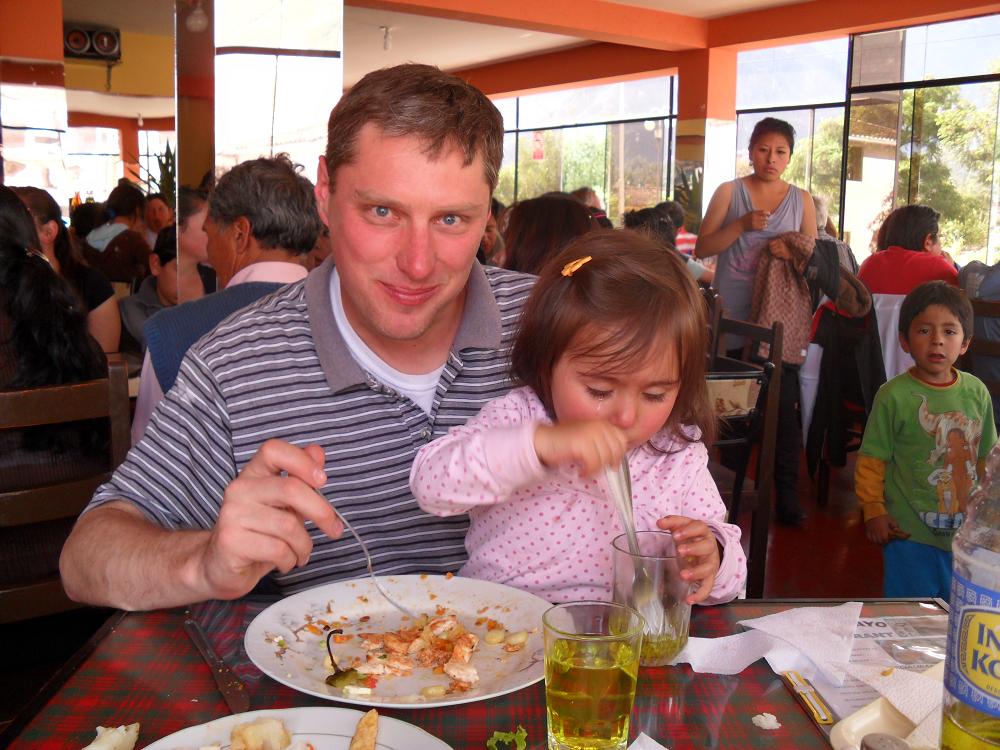
After that we had an uneventful trip and a wonderful Easter dinner. Brianna ran around the restaurant and generally acted like the lovely little hellraiser that she is, but at least no food got thrown at anyone 😉

Typical Peruvian food

Typical Peruvian food

Easter dinner!

Easter dinner!

Papi can smile and chew at the same time!

Papi can smile and chew at the same time!

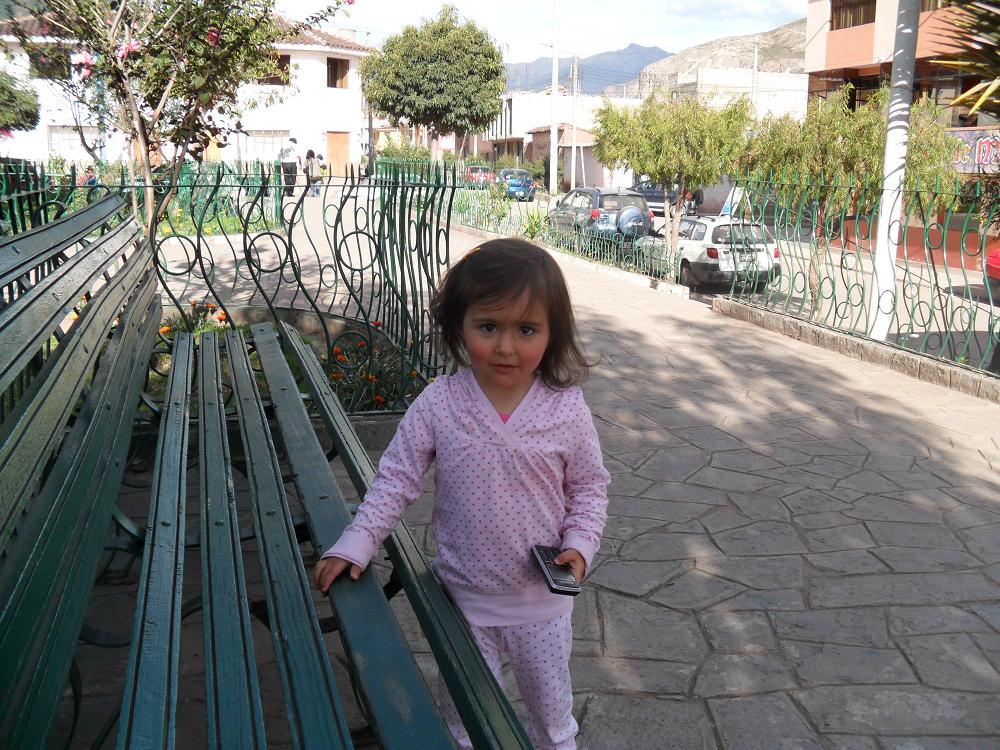
Playing in the park after Easter dinner

Playing in the park after Easter dinner.

Peru presidential elections – Unseriously

Round 1 of the 2011 Peruvian presidential elections is over. The June runoff will be between Keiko Fujimori and Ollanta Humala (some background about the candidates here).

Most of our friends don’t care much for either candidate. Among other things, Ollanta Humala wants to re-write Peru’s constitution, likely giving more power to the poor and less to business and foreign investment.

I thought I’d have a little fun on my Facebook page and see just how much bad stuff about Ollanta the typical jeans-wearing, iPhone toting, middle-class Peruvian (ie. most of our friends) would believe.

Facebook screenshot Ollanta Humala

Facebook screenshot Ollanta Humala plans to outlaw Peruvians marrying gringos 🙂

(click on the image for full size)

The people who commented on my silly joke are all good friends and good people (and not all are Peruvian), but it does show how easy it is to plant irrational fear (Glenn Beck anyone?) about anyone whose ideology may not correspond with your own.

The first round election result is fairly interesting, because both Keiko and Ollanta have their followers but there’s also a significant part of Peru’s population (mostly middle class and business establishment) who don’t like either. The fear is that Keiko will bring back more corruption and Humala may upset business and foreign investment to some extent. Peru’s presidential election runoff is almost akin to, say, a choice between Ivanka Trump (daughter of a famous person) and Michael Moore.

My personal input to the Peruvian presidential elections is only this:

1) As a visitor/guest here I don’t care who becomes Peru’s next president. However the Peruvian people choose to govern their country is up to them and I’m privileged to be here as a guest.

2) No matter who wins the runoff, I don’t think there will be a significant change in daily life in Peru. Even though both candidates are seen as potentially having some issues, I think Peru’s society is strong with very close families, reasonable institutions, a fair economy, etc. Politics here can be interesting and colorful, but in my view politics are not that big of a factor in society.

PPK tocando flauta

I said I’d stay away from politics and that’s still true. However with the Peruvian presidential election campaigns coming to a close you can’t get away from it. The upcoming election (Sunday) does promise to be interesting, with Alejandro Toledo, Keiko Fujimori and PPK (Pedro Pablo Kuczynski) all in a close race for second place behind Ollanta Humala. The 2 candidates with the most votes go to a runoff election in June.

During his televised “closing rally” in Lima last night PPK played the flute as he often does before his stump speeches. Regardless of politics, I’d have to think he’ll get a few extra points for this.

Peru presidential elections are almost here

Peru’s 2011 Presidential elections are almost upon us. April 10 is the big day, and I believe tonight is the final televised debate between the leading candidates.

Let me say 2 things first:

1) I am a guest in Peru so it doesn’t matter to me who wins or loses. I’m privileged to be here and however the Peruvian people choose to govern their country is up to them.
2) I’m Belgian, so you should never take my advice on any matters of politics or government. When it comes to politics, the only thing we Belgians can say is “Thank God for Italy!”

Having said all that, here’s a few notes about the leading candidates in Peru’s upcoming 2011 Presidential elections, for no purpose other than to show how the candidates come across to a gringo. Official bios, photos, web pages and the like can be found here.

1) Alejandro Toledo: He was Peru’s president from 2001 to 2006 and was first Peruvian president of native Indian (Quechua) heritage, but his politics were free-market oriented. He left office to rather low approval ratings, due to the fact that many felt the macro-economic gains that were made did not extend to all Peruvians. On the other hand, nothing bad or particularly controversial happened during his tenure, which was a welcome change from the late 20th century. He’s considered a strong candidate in the upcoming elections, but I know someone who knows some people who know Toledo and say less than favorable things about him.

2) Lucho Castañeda: He was mayor of Lima (home to about 30% of Peru’s population) from 2003 to 2010 and enjoyed generally good approval ratings, easily winning re-election. He implemented the Metropolitano bus system in Lima, which has to be regarded as a great success – although it’s only a small first step in Lima’s transportation solution. Otherwise I don’t know much about Castañeda’s ideology. He’s divorced and conventional wisdom says he has little chance of becoming president without a first lady.

3) Ollanta Humala: He’s the villain of them all, widely painted by his opponents as a “leftist” of the same mold of Evo Morales and Hugo Chavez. Humala narrowly lost the 2006 Presidential elections. He seems to have moderated his stance on some issues like foreign investment, but he remains a controversial figure. His opponents and the establishment in general paint a sad picture of Peru heading for the same abyss as Bolivia under Evo Morales should Ollanta Humala be elected, ignoring the fact that Bolivia has one of the fastest growing economies in Latin America and Evo enjoys high approval ratings. But since when does reality trump ideology in this world? Of all the leading candidates Humala is the only one who’s married to a Peruvian, so at least outside of politics he has good judgement 😉

4) Keiko Fujimori: She’s the daughter of former Peruvian president Alberto Fujimori. Her father was president from 1990 to 2000, when he was driven out of the country by a popular revolution. During Alberto Fujimori’s regime, Peru saw an end to terrorism and the economic chaos of the 1980s, but his regime was also marked by human rights abuse and corruption, especially in later years. Keep in mind that Peru has a very young population (partly due to the stability that was brought under Fujimori) and something like 20% of the voting public has no adult memory of Fujimori’s presidency. However, there has remained a strong “Fujimori” following and political party in Peru, led now by his daughter Keiko. I don’t know much about Keiko’s ideological convictions, but her VP candidate is ultra-conservative. I guess Keiko has a chance only if someone can be elected president just for being the child of a well-known ex-president. Eerrrgh, wait, where did I see that one before?

5) PPK or Pedro Pablo Kuczynski: He’s Patricia’s favorite, and the favorite of many of her friends as well. I have a PPK poster on the window, but my dog barks at it. It has to be said my dog is one of the dumber dogs you’ll ever meet. In seriousness, PPK is perhaps the most Western of all the leading candidates. He held US citizenship (I think he renounced it before the elections) and has worked on Wall Street. He has a free-market ideology and as minister of economy under Toledo should take some credit for the macro-economic gains that Peru has made. Although I’m not a fan of this ideology (ie. what’s good for business is good for everyone), I have to say that PPK appears to be a thoughtful and reasonable person, and considering his age and previously successful career I would be more inclined to believe that he’s running to serve the country as opposed to running in order to make financial gain for himself and his inner circle.

Finally, it always strikes me how so many politicians no matter where you are would like you to believe the world as you know it would end without their magnificent leadership. Consider this quote from the Ottawa Citizen about Belgian politics, titled No Government, No Problem:

Take Belgium, for instance. It’s a European country riven by ethnic tensions. Its public debt is almost as big as its total annual output and it’s in the middle of a political crisis so deep that this week it passed Iraq as the modern-day state whose politicians have taken the longest to form a government.
Yet the buses run more or less on time, the garbage is collected twice a week, exports of pharmaceuticals, chocolate and beer have gone on without interruption and it can still take about a month to get a new telephone line. Life goes on.

And that quote is more than a month old by now, still no Belgian government, beer exports are still going on fine 😉

Cortesia

Not many popular artists come to perform in Cusco. A lot of well known acts come to Lima, but rarely to Cusco. This past week was an exception: the popular Venezuelan duo “Chino y Nacho” came to Peru. You may never have heard of “Chino y Nacho” up North, but they have a number of hits and are very popular here in South America. Here they are performing one of their recent hits, “Mi Niña Bonita”:

(sorry, I noticed after I posted this that their videos are only on youtube directly)

I had to leave town for a work trip just a few days before “Chino y Nacho” came to Cusco but I decided to buy 2 tickets anyway, so Patricia could go with her sister or a friend.

My cousin Monica:

One thing I should mention is that it is still common to have large families in Peru and a generation or two ago, large families were the norm in Peru. Patricia has a big family on both her mother and father’s side. Like in most families, we’re closer to some family members than others. Likewise, it’s not unusual here in Peru to be close to someone who’s technically a distant relative.

Monica is one of Patricia’s cousins, 17 or 18 years old I think. We’d probably refer to Monica as “distant family”, I’m not sure if Patricia had even met her up to a few years ago. We’re not close but I occasionally run into Monica in town and we were always very friendly and cordial.

A few days before the concert I decided to stop by “Mega”, the big store near our house, and buy 2 tickets to “Chino y Nacho”. As I was walking up to “Mega”, I spotted Monica out in front of the store. She was dressed very nice to attract attention and had a stash of “Chino y Nacho” flyers in her hand. With her was a boy selling tickets. Nothing unusual, you often see young women dressed nice or flashy to attract attention and sell or promote something in front of a store. We talked for a while and I bought my 2 tickets to “Chino y Nacho” from my cousin Monica and her friend.

Normally I would never buy something like that in the street in Peru. There’s a huge “informal economy” in Peru, street vendors sell anything from ice cream and candy to books, arts, crafts, pirated DVDs, you name it. Something like tickets I would normally never buy in the street, because there’s a lot of fake or pirated stuff out there. I even asked Monica, “These aren’t “bamba”, are they?” (bamba=fake). But I bought her tickets anyway, you know, she’s my cousin…

I gave the tickets to Patricia and instead of being happy she was mad at first, because she didn’t want to go to the show without me 😦

Then I left for my trip to Lima and the US and all was well. However, a day before the concert Patricia called all excited and asked how much I paid for the tickets. I told her the story, all proud and happy that I had bought the tickets from her cousin who had sold me two S/.65 tickets for S/.60 a piece.


“Noooooooooooo!!!”

“You paid S/.60 for free tickets!!!!”

As usual, Patricia was right: the tickets say cortesia (courtesy) right on them. There’s no price printed on them. They are free tickets. I should have known…

Turns out Monica was working as event staff at the concert and somehow “obtained” a stash of free tickets, which she subsequently sold to unsuspecting fools like me. Probably most people were smarter than me (not difficult to do), noticed that they were free tickets and “bought” them at a significant discount. It wouldn’t be unusual for someone to get a few free tickets and sell them at half the value of a paid entrance, but S/.60 for S/.65 tickets??? To your own cousin!!!!

Oh well, live and learn. There is so much “bamba”, pirated or otherwise useless stuff in the “informal economy” in Peru. Never buy tickets in the street in Peru, not even from your own cousin 😉

Featured: Don’t land in the Pisco!

I finally got my Peruvian pilot’s license a few weeks ago. I’d worked off and on over the past 6 months to convert my licenses. Didn’t have time or money to work on my license full-time, that’s why it took so long. Plus everything had to happen in Lima… that’s one of the bad things about Peru, when you live in the provinces you have to go to Lima for practically any significant government issue.

Anyway, here’s a teaser from my flying blog about taking the flight test for my Peruvian pilot’s license:

Coming back to the checkride, as we were doing maneuvers just north of the “Rio Pisco”, about 10 miles north of the Pisco airport, the DGAC examiner cuts the engine. All 105 mighty horses in the Cessna 152 decided to quit on me at the very same instant.
We were at 3,500 feet at the time. I looked to Pisco airport in the distance and realized I couldn’t make the airport. I told the examiner I’d land on some green fields I spotted nearby.

For all the excitement go read “Don’t land in the pisco!” Since you’re reading this, you already know it all ended well 😉

Wendy Sulca: Peruvian teenage pop/folklore starlet

I hardly watch TV, but recently it seems like every time a TV is turned on in the room, there’s some show or feature with Wendy Sulca.

Wendy Sulca was a Peruvian child singer who became popular on YouTube and Peruvian TV shows. Now she’s becoming a bit of a teen starlet.

Wendy Sulca is typically introduced as “niña de folklore” and she signs traditional Huayno music, but in my opinion she’s really a pop/folklore crossover. Here she’s singing a Spanish version of Madonna’s “Like a Virgin”.

Wendy Sulca’s most recent hit is “In Tus Tierras Bailare” (in your lands I will dance), where she sings together with La Tigresa del Oriente (The Tigress of the East), and Delfín Hasta el Fin. Alma Guillermoprieto wrote an interesting review of “In Tus Tierras Bailare”.

Some people make fun of her childish voice (according to Wikipedia she’s only 14), but I like her posture and composure on stage, she’s very engaging with the crowd or camera.

According to Wikipedia, Wendy Sulca was born in San Juan de Miraflores, a poor area of Lima. In the official video of her popular song “La Tetita” you see her in the traditional folkloric dress in small towns in the Peruvian countryside, but life in San Juan de Miraflores is nothing like that.

Ticos are dying

The Tico is a small car that was produced by Daewoo. In the 1990s, thousands were imported to Peru, mostly for use as taxis. I don’t think Ticos would be street legal in the US or Western Europe (although I have seen some in Poland), but here in Cusco the fact that they are so small and maneuverable actually made them quite handy.

When I first visited Peru in 2005, it seemed like 80% of the taxis in Cusco were Ticos. You see many of them in other parts of Peru as well, but I think Cusco was like the Mecca of Ticos, because the narrow city streets were perfect for the Tico. In Lima you see some Ticos, but when you’re on a major highway like the Via Expressa, riding in a Tico is pretty scary.

Considering that most Ticos are used as taxis and circle the potholed streets of Cusco 12 or 14 hours a day, it’s quite surprising that they have lasted this long. However, the Ticos are really showing their age now.

Tico has seen better days

This Tico has seen better days

Most Ticos are not quite in as bad a shape this one that I saw parked along the Panamericana highway, but when I’m hailing a taxi I now often pass up a Tico to wait for a better car…

In the years since I’ve been visiting Peru, Ticos are noticeably becoming a smaller part of the taxi fleet, with more and more new cars taking their place – mostly Toyota, Suzuki, some European brands as well as the Chinese brands such as Chery and Jac.

Mean Fat Pituca

NOTE: here in Peru the word “pituco” or “pituca” is used to describe arrogant or snobbish people who flaunt their money or status.

Just this morning I was walking along Av. Aramburu in Lima, going to Av. Arequipa to catch my combi. Aramburu is the dividing line between the wealthy financial district of San Isidro and the less affluent district of Surquillo. At the busy intersection between Aramburu and the “Via Expressa”, you may find the occasional panhandlers or homeless people, as well as streetvendors selling anything from pirated movies to anticuchos.

As I was walking past the “Via Expressa” bridge, one homeless lady in the street was holding out her hand. Right in front of me a snobbish-looking middle-age fat woman reached into her pocket, pulled out a crumpled up piece of paper, and with an angry snarl she threw this piece of paper right at the poor woman’s face.

I wanted to yell at the fat pituca b*tch, but I didn’t. Maybe I didn’t feel like making a scene, maybe I didn’t want to be a hero, or maybe I was just in a hurry. I’m not sure why, but I just shook my head and kept walking.

I understand the wealthy and middle class in Lima may feel insecure or infringed on by the poor, I really do. There’s a lot of wealth in places like Miraflores and San Isidro, surrounded by a lot of poverty in places like Callao or San Juan de Miraflores. And it’s not just money, also the way of life, the history, the massive migrations to Lima, and of course crime, that have created some degree of tension and social discrimination.

I don’t know the answers, but there was just no reason for that.

Pisco in pictures

I had a chance to visit the town of Pisco a few times recently. Pisco is about a 4-5 hour busride south of Lima, and best known as the namesake of the famous Pisco Sour drink (more on that later).

I’m not a great photographer, but here are some random pictures of my visit to Pisco (click on the pictures to enlarge):

A street leading to the main square in Pisco, Peru

A street leading to the main square in Pisco, Peru

Plaza de Armas, or main square, in Pisco, Peru

Plaza de Armas, or main square, in Pisco, Peru

The church on the main square in the town of Pisco, Peru

The church on the main square in the town of Pisco, Peru

You can see some construction going on next to the church. The town of Pisco was hit by a serious earthquake in 2007. It was hard for me to tell exactly what’s ongoing reconstruction from the earthquake versus some of the typical half-finished buildings you see in Peru, but there is still obvious earthquake damage in the area.

I think most of the economy in Pisco consists of growing grapes for the “Pisco” drink and fishing. Pisco also has a shared civilian/military airport, a relatively large seaport and some oil and gas installations. You can see the oceangoing ships in the background.

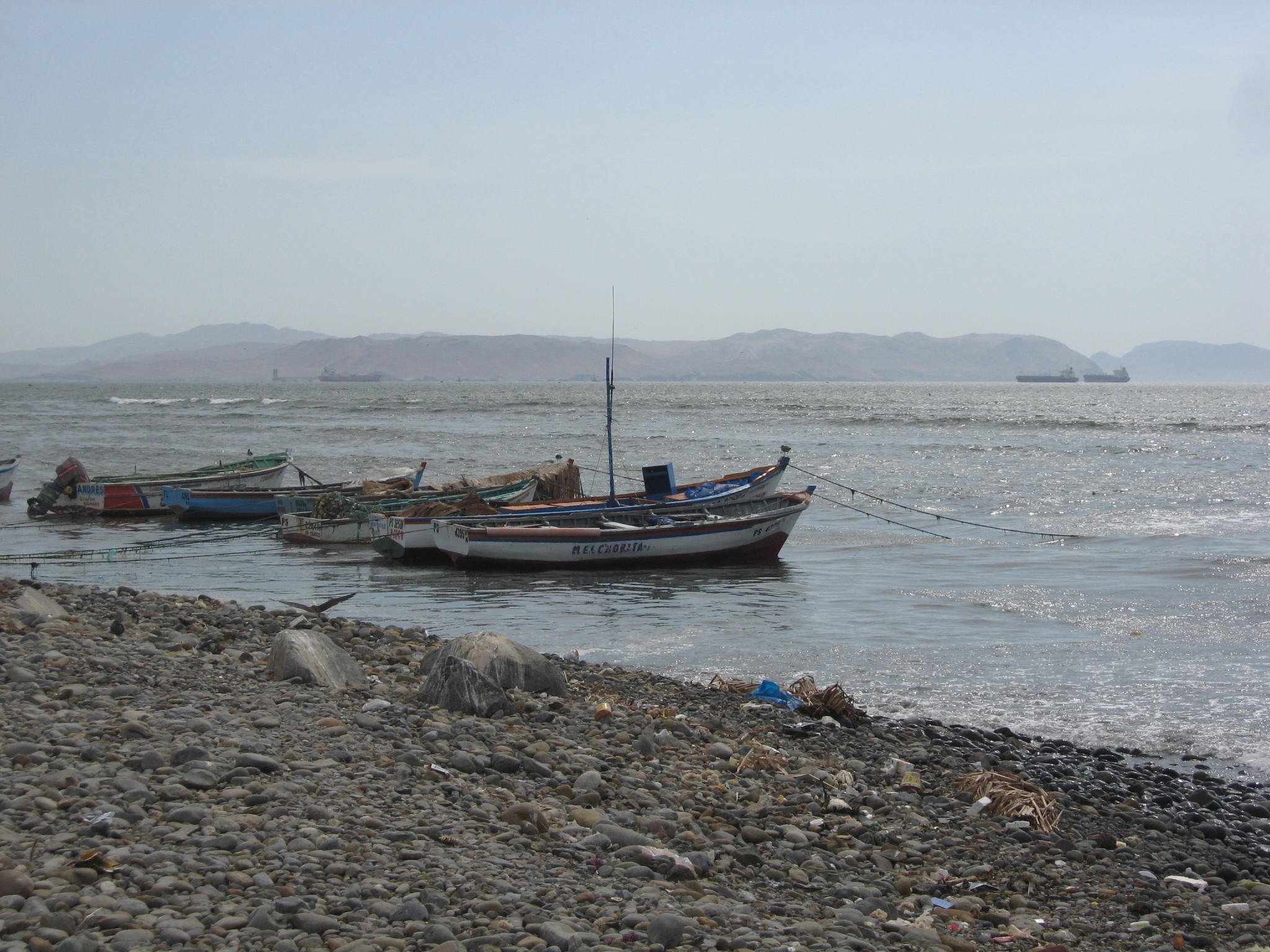
Small fishing boats in San Andres

Small fishing boats in San Andres

I stayed in the small village of San Andres, on the Pacific coast about 5 minutes from Pisco. San Andres is a very quiet seaside town, but a few tourists do come through there to get to the Pisco airport for scenic flights over the famous Nazca lines.

The seaside village of San Andres, near Pisco, Peru

The seaside village of San Andres, near Pisco, Peru

Birds on the beach in San Andres

Birds on the beach in San Andres

The beach in San Andres, near Pisco, Peru

The beach in San Andres, near Pisco, Peru

Near Pisco you also find the Paracas National Reserve and the Ballestas islands, where I was told you can find really beautiful beaches and a resort-style hotel, but I didn’t have time to go there.

In San Andres I stayed at the hostal “La Jalapa”, which is a very quiet and pretty hostal just at the edge of the town. It has nicely kept green areas, a pool and restaurant. I paid the silly rate of S/.30 per night and was very happy.

Hostal La Jalapa in San Andres, Peru

Hostal La Jalapa in San Andres, Peru