Merry Christmas – part 2

So many great Christmas songs… One of my favorites is this one from Freddie Mercury and Queen. If you think of the great front-men of rock, people tend to name names like Robert Plant or Steven Tyler or Mick Jagger, but when you look at Freddie Mercury’s live performances – whether you like his style or not – he’s just an incredible performer with few if any equals. R.I.P. Farrokh Bulsara.

Merry Christmas to all!!

Merry Christmas

Merry Christmas to all!

We have our Paneton and hot cocoa ready, and surprisingly our Christmas tree has actually managed to stay upright until now… with our wild little baby goose I had given it about 60/40 odds of being knocked over before today, but I’m glad to be wrong on that prediction.

We will spend Christmas Eve together with family in the Peruvian tradition. We’ll stay up through the night, exchange gifts and eat dinner at midnight.

We decided to skip the nativity scene in our home this year, because said little baby goose doesn’t yet know the difference between toys and nativity scene, so it would just end up strewn all over the floor with the rest of our worldly belongings 😦

I’ll leave you with a picture of the typical Andean Baby Jesus figure, which shows the strong influence of the native Quechua culture on the Christian religion. Just beautiful.

Typical Andean baby Jesus figure

Typical Andean baby Jesus figure

Merry Christmas!

Alcohol in Cusco

I saw a funny drunk the other day. I don’t know what it is about Cusco, or the highlands of Peru in general, but it seems like heavy drinking is more common here than in the coastal parts of Peru or elsewhere. That’s just casual observation, no proven statistics or anything of that nature.

I don’t know what the reason might be, it could be because life here in the high Andes really is tough due to the climate, geography and high elevation, I really don’t know.

Like most people we enjoy drinking socially at times, but unfortunately we also know a few people who are habitual drunks and have let their alcoholism really affect their lives in a bad way. I’m hoping most of the time when I see someone stumbling around drunk out of their mind that it’s not a habitual thing.

At any rate, back to my funny story. Now this is one of these stories that really can’t be told…

You had to be there:

The other day I was getting my hair cut at a local barber. My “casero” (ie. regular or regular customer) works out of his house on Av. Cultura, a busy main street in residential Cusco, not the tourist areas downtown. While I’m waiting to get my hair cut, many people walk in and out of his shop, schoolkids come in to buy candy, etc. Some friends or family walk into his shop, say hello and then go to the back of the house.

Just as it was my turn to get my hair cut, a guy drunk out of his mind came stumbling into the barber shop and mumbled something to my “casero”. My “casero” replied something I couldn’t understand, I think they were speaking Quechua, but it was obvious my barber knew this person. The drunk was a guy maybe in his fifties, well dressed in a suit and shirt but with a scraggly unkept beard.

The drunk disappeared in the back of the house for a few minutes and then returned. He sat down next to a couple of other customers who were waiting in line. A minute or two later, the drunk got up and started talking to the other customers. He was speaking Spanish at that time, but I couldn’t understand a word he said because his speech was so slurred. I think he was pointing out something in the tabloids that are laying around the shop for waiting customers.

Next thing you know, for no obvious reason, this drunk guy puts his hands on the couch (where customers were waiting), feet on the floor and starts doing push-ups. Not just one or two, but maybe 10 or 15. A 50-some year old guy in a suit, drunk as a sailor, doing push-ups in the middle of a barber shop, you just had to be there.

My “casero” and everyone else in the shop just sort of chuckled, and after a little while the drunk said something else to each of the people in the shop, I didn’t understand anything except that he said “50 cents” several times. Then he walked out into the street and disappeared, as quickly as he had shown up he was gone again.

* * *

This crazy scene reminded me of another event, different but similar in its stupidity.

A while back when I was teaching an early class at ICPNA I would get up at 6:00 and walk the dogs before heading into work. These 2 mutts:

Roxi and Manchita, with our baby Brianna

Roxi and Manchita, with our baby Brianna

Our dog Manchita

Our dog Manchita

One morning just after 6:00 I was walking the dogs in the park by our house, and another stumbling drunk shows up. He’s holding a plastic cup in one hand and a bottle of beer in the other. He’s happy as can be and when he sees us, he decides to walk towards us and starts offering me and the dogs some of his “cerveza”.

“Hey, let’s have a drink, let’s all be friends.” – Seriously.

Now it must be said that our dogs are really quite protective. I don’t let anyone other than myself walk both of them at the same time. They’re not aggressive or bad dogs, but they are protective and don’t like being approached by strangers, especially men. I don’t know what it is because we found both as strays, perhaps they were abused or something, but both dogs do not like men they don’t know. The Jack Russell looking one is the oldest and most dominant, and the fat pitbull-looking one has never had an original thought in her life, she just barks and growls when her “big sister” barks and growls.

So this happy drunk came stumbling towards us offering the dogs a drink of cheap beer (I think it was Brahma or something) and the dogs start going nuts, barking and pulling on their leashes. I’m pulling the dogs out of the way as quickly as I can, but this drunk keeps coming at us:

“Hey, let’s all be friends.”

I’m not making this up. By now the pitbull is raising her hair and pulling her lips and the idiot drunk still wants to make friends. I luckily was able to pull the dogs away and make my way out of the park quicker than the drunk could follow us. I don’t think the guy remembers any of this, he was so happy drunk out of his mind, but he’s very lucky he didn’t try the same thing with some 7-year old kid walking his dogs.

Peruvian beers

Peruvian beers

Enjoy the holidays! Drink responsibly 😉

People are People

One thing I’ve learned over the years from traveling and living in different cultures, is that there’s an undeniable and strong effect of our culture on how we live our lives, but at the end of the day people are still people and as individuals there are certain things that hold true no matter the culture. For example, we all worry about our kids doing good in school, our parents growing old healthy, etc.

Here’s another perfect example….

This morning I woke up early, around 6:00. I got up to use the bathroom but then decided I’d go back to sleep for a little while. Around 7:00 Patricia woke up as she normally does at that time. I stayed in bed a few more minutes.

However, for some reason Patricia decided to start folding clothes and putting clothes away in our room, which she normally does not do so early. Next thing you know, the baby woke up and started to fuss. I got up and the day began.

Since the baby normally sleeps until around 8:00, she was really fussy for having woke up an hour early. So I asked Patricia: “Why did you start putting clothes away while the baby was still sleeping and woke her up so early?” In my mind the baby clearly woke up because Patricia was doing stuff in our room.

Answer: “The baby woke up because you got up early.”

Errrrrrrgh, say again? The baby got up at 7:00 because I went to the bathroom at 6:00?

We went over the same conversation again about 3 times and the logic never did make sense to me.

The baby woke up early at 7:00 because I went to the bathroom at 6:00, but the fact that mamacita was folding clothes and putting clothes away in our room right at the very moment the baby woke up, had nothing to do with it.

And then it hit me, it was my fault that the baby woke up early, because:

IT’S ALWAYS MY FAULT, BECAUSE MARRIED GUYS ARE ALWAYS AT FAULT. EVEN IF IT’S NOT MY FAULT, IT’S STILL MY FAULT.

That’s just one of these truths of life, no matter where you are, married guys are always at fault. And that’s okay, just like worrying about your kids doing well or your parents staying healthy, some things in life should never change 😉

Boleteros and little lies

I guess everyone tells a little white lie sometimes.

The 4 year old who asks how you liked his singing or drawing:

Answer: “I loved it sweetheart”

Someone special cooked or prepared something that maybe wasn’t your favorite:

Answer: “I loved it sweetheart”

All pretty commonplace and harmless. But I think little lies are more common in Peru than in the US, just casual observation.

When I was teaching ESL the students would constantly tell me little lies about their absences, even when it was blatantly obvious. One day there was a big Cienciano soccer game. This was a few years ago when Cienciano, the local Cusco soccer team, was pretty good in Peru. The game was at 9:00 pm. One girl came to me at the beginning of my evening class and asked for permission to leave early, around 8:45. When I asked her why, she said “eerrgh, I have to attend a meeting at 9:00”, without even making an effort to sound sincere.

I grabbed her by her shoulders and turned her towards the class…

“Hey class…
Andrea wants to leave early, around 8:45
You can all see she’s wearing a red shirt …
a red hat …
and red shoes”

Everyone laughing, red being the colors of Cienciano.

“And she said she’s going to a meeting at 9:00…”

I’m sure she hated me 🙂

Even the staff at our institute was a bit like that. For example, we had various weekend meetings and events that I often couldn’t make, because it was just a part-time, evening fun-job for me. Every time some of the other teachers suggested if I couldn’t make a meeting that I’d tell the academic director something like “I have to travel this weekend” or “The baby is sick” etc.

In my professional experience back in the US, that would be a big no-no. At GE you didn’t make up excuses, if you couldn’t be somewhere for personal reasons, you just say it’s a personal reason.

Anyway, back to the boleteros. If you’re not familiar with public transportation (buses/combis) in Lima, most buses have both a driver and a “boletero” who takes the passengers fares and yells out the bus route at each stop. For my IO-30 combi from Miraflores to Breña, it goes something like this:

“Larco, Ovalo todo Arequipa. Arequipa Arequipa todo Arequipaaaaaa”

And when the bus gets a bit further down Av. Arequipa, the boletero yells at each stop:

“Todo Arequipa. Arica Arica Duenas. Arica Arica Duenaaaas”

Keep in mind that the boletero’s job is to try and get as many people in the combi as possible. More passengers means more money. The busses get full pretty quick in many stretches, so when there are empty seats the boleteros often yell “Hay asiento” (there are seats) and when the car is practically empty, they sometimes say “Carro vacio”, meaning, empty car.

Now twice in the past week the following happened to me:

I was in a combi which was full of people leaving Miraflores, and I’m standing in the aisle. Not real comfortable for someone 6’3″, but no big deal either. As we got further down Av. Arequipa, some people jumped out at their work or school, and I found a seat. Moments later at the next stop the boletero jumps out…

“Arequipa todo Arequipa… hay asientos”

Fair enough. Another stop later:

“Arequipa todo Arequipa… hay asientos. Carro vacio, Carro vacio”

I just couldn’t help but look around and count the empty seats. There were 2, no mas. 2 out of about 20 seats are available – no exaggeration – and the guy jumps out in a street full of people and yells “empty car”, “empty car”.

This happened twice on different cars. No big deal, it just sort of reminded me that little lies are often a bit comical and seem more prevalent here in Peru than back in the US or Europe.

I was expecting boletero to offer hot meals and on-demand movies next 😉

GianMarco 15 Años

Watched the entire “GianMarco 15 Años” movie on the bus to Lima today, a great show taped in Lima’s Estadio Monumental in 2005.

Thanks to the wonders of YouTube, we can share a good bit here. Watch the whole thing, it is well worth it.

Around 4:20 it gets really, really good. He stops for a moment and says:

“Peru is the most beautiful place, we must take care of it”

I don’t like Miraflores

Other than the Plaza de Armas and historic downtown Lima, Miraflores is probably the best known district of Lima, and the district most visited by tourists. I’m staying in Miraflores at the moment, have stayed here several times before, but I have to admit I don’t really like Miraflores.

To be fair, Miraflores has it’s charm. It’s a beautiful seaside location, home of Parque del Amor, the Malecon verde, Larcomar, etc. In the center of Miraflores is Parque Kennedy, where you always find a mixture of arts, entertainment, restaurants and shopping.

Miraflores is also a center of business and location of the main offices for many companies – which is why I’m staying here at the moment. Miraflores is decidedly more western or cosmopolitan than most other areas of Lima and Peru.

Parque Kennedy in Miraflores, Peru

Parque Kennedy in Miraflores, Peru

So what’s not to like? It just seems like Miraflores, being the center of business and a big tourist destination, has lost some of the things I like the most about Peru. The warmth and friendliness of the people, the laidback way of life that I’ve come to expect in Peru has been lost somewhat in Miraflores to the hustle and bustle of life in the big city.

The main tourist areas around Parque Kennedy and Larcomar are also quite sleazy at night. As a middle-age white guy (the worst demographic, but that’s another story), walking around Parque Kennedy by myself I constantly get hustled for sex and drugs. Just of Parque Kennedy is so-called Pizza Alley, a little street full of pizza restaurants, bars and discos, all more sleazy than Parque Kennedy itself. Before I ever moved to Peru, a Peruvian friend of mine told me if you really want to enjoy the nightlife in Lima, go to places like Barranco or Lince instead of Miraflores and Larcomar.

There are also many beggars and homeless people in downtown Miraflores, but not really in a way that you would empathize with. That’s not to be inconsiderate, I’ve seen many poor people in different settings from Honduras to Peru to the train stations in Europe, and the truth is that places like Parque Kennedy (or the Plaza de Armas in Cusco) just seem to attract people who hustle more than someone who just happens to be down on their luck.

I’m not saying you can’t go to Miraflores and have a good time, just that you’ll be paying extra not to see what the rest of Peru really is like.

Rant over. I’m walking down the street now to have chicken wings at Hooters in Larcomar 🙂

Cooking in Peru

Much has been written about the many great foods of Peru, but let me give you some insight in the process of cooking, how that great yummie food ends up on our table.

Now my experiences are not representative of all of Peru. There is a world of difference between the elite in Miraflores who have beautiful grocery stores, cooks and maids, and the rural population who live of the land and cook on a fogon. I can only speak from my own experiences living in a middle-class area of Cusco.

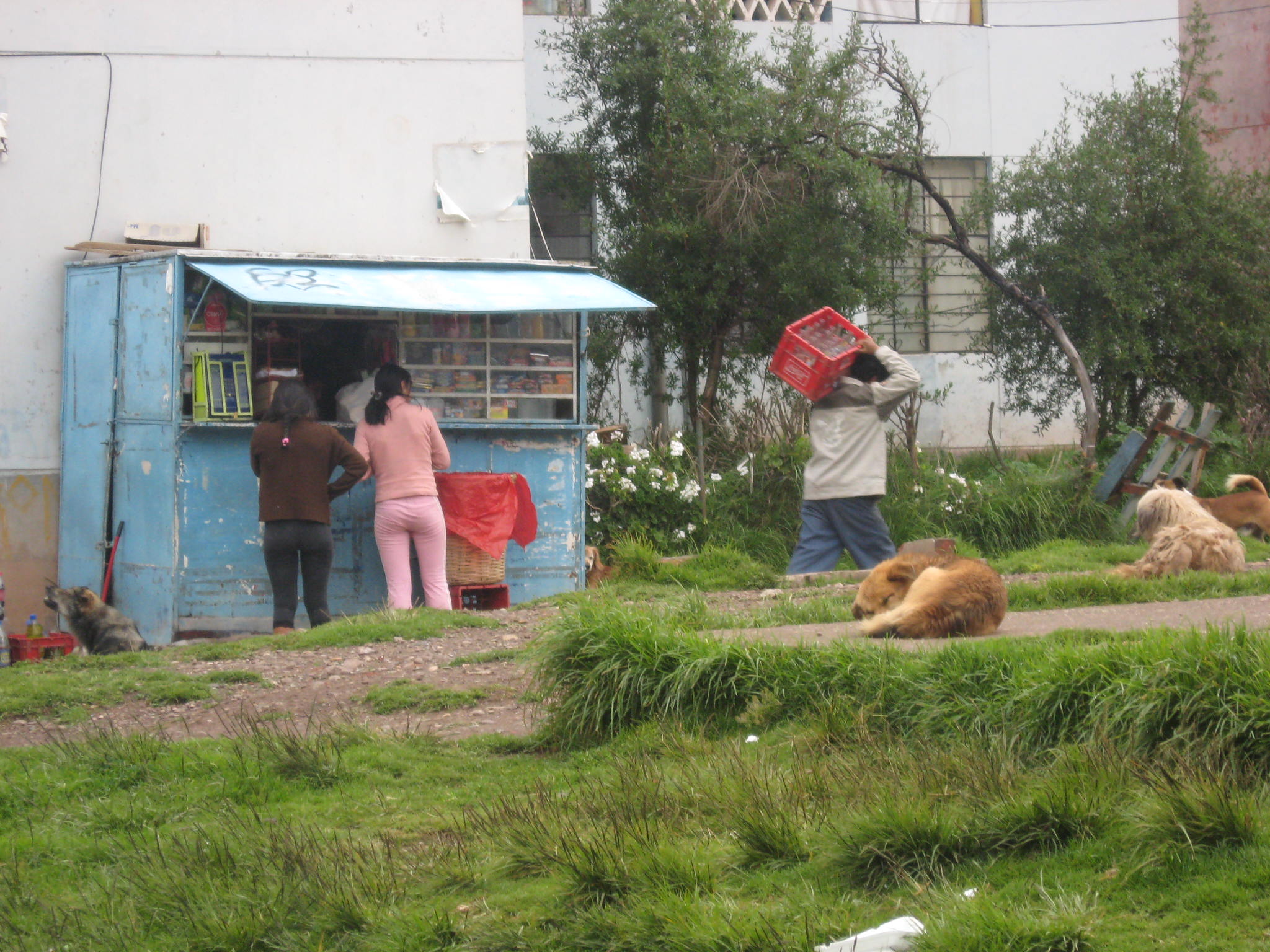
What you need to know in order to grasp the concept of cooking in our neighborhood, is that there are many small stores and very few larger stores in Cusco. In our complex, there must be 6 or 8 of these 1-man or 1-woman stores, like the one in the picture below. Each store is about the size of a big pantry and serves maybe 2 or 3 apartment blocks.

One of the little stores in our neighborhood

One of the little stores in our neighborhood

Just for contrast, a little bit of background about the process of cooking in the other cultures I’ve lived in:

Cooking in Belgium:

Belgian people are super-efficient, in an old-fashioned, hard-working, German kind of way. In addition, for many in the graying population, the Depression and World War 2 are only a generation away, so their comfort level is to stock up a ton of food in their pantries, freezers, etc.

In my house, this is how we used to cook:

(1) Dad peels potatos — God knows Belgians eat a lot of potatos.
(2) Mom gets meat and vegetables out of pantry / fridge / freezer.
(3) 20 minutes later everyone’s at the table eating and another 20 minutes later the dishes are done.

Cooking in the US:

In the US people do everything big, not just in Texas. Twice a week I used to stop at the grocery store on the way back from work and spend $100 or more on groceries. I’d eat as much red meat in a week as I do now in 2 months. Seriously.

(1) Drive home, fire up the grill.
(2) Open bag of salad and put baking potato in Microwave.
(3) 15 minutes later dinner is ready.

Cooking in Peru:

Let’s take a typical weekday, lunch is the big meal. The cooking is usually done by mamacita or my suegra.

12:15 – Hey, it’s time to start cooking.

12:17 – I’m going to Señora Maria’s store. (see above).

12:22 – At the store, there are three or four other ladies from the neighborhood. Everyone talks, and talks for a while.

12:47 – I’m back from the store. Time to cut the vegetables.

12:57 – Holy guacamole, you realize you forgot to buy onions.

12:59 – You go back to Señora Maria’s store only to find out it is now closed, Señora Maria is also cooking. No problem, you go to another “store” 200 yards away.

13:05 – The lady at the other store has the new Avon / Esika / L’Ebel / Leonisa or whatever catalogue, so you check it out.

13:24 – Walking back to the house with your 2 cebollas, you run into your friend from “collegio” and talk for awhile.

13:48 – Back at the house you chop up the vegetables and potatos and throw them into the trusty pressure cooker along with some noodles. Soup will be ready soon.

13:50 – Don’t forget the rice. I think Peruvians eat more rice than Belgians eat potatos.

14:02 – Time to set the table.

14:04 – Yell at your ayudante (in our case, my sister in law). Helen, Heeeleen, Heeeeleeen.

14:12 – Tell Helen to go to “the store” and buy something to drink. Helen and my suegra then argue about what kind of soda to buy and how much money to spend.

14:15 – Food for the wawa (baby) is ready. Papi feeds the wawa.

14:26 – Table is set, Helen came back with soda, soup is served.

14:35 – “Segundo” or the main course is served.

15:50 – Table is cleaned and dishes are done.

Until tomorrow, then we do it all over again 🙂

I have to work 10% harder this year

The man who destroyed my previous employer (or at least he spearheaded the destruction) invented this illusion of 10% earnings growth every year. That kind of corporate BS is NOT what I’m talking about here. In my case, it’s a plain and simple truth: if I want to have about equal income every year that I’m in Peru, I have to work a good bit harder every year.

The reason is that most of my work as a contract pilot or consultant is paid in US dollars, but my groceries are paid in Peruvian Nuevos Soles.

And here’s how the US dollar has been fairing against the Nuevo Sol this year:

US$ vs Peruvian Nuevo Sol - 1 year chart

US$ vs Peruvian Nuevo Sol - 1 year chart

And 5 years:

US$ vs Peruvian Nuevo Sol - 5 year chart

US$ vs Peruvian Nuevo Sol - 5 year chart

View charts at XE.com.

Here’s an article about Peru’s central bank as well as the central banks of other so-called developing economies taking measures to prevent their currencies from rising too much:

And here are Peru’s foreign currency reserves over the past 10 years, standing at around $40 billion at this moment. Chart shamelessly robbed from IKN:

Peru foreign currency reserves

Peru foreign currency reserves

Now foreign currency rate swings are nothing new and I am not predicting the demise of the US dollar or the end of the world here. But it should come as no surprise that consistent near-zero interest rates and monetary easing (printing money) in the US will erode its currency’s value.

When I was a young boy in the early 1980s and Belgium developed large budget deficits and high unemployment, I could not understand why the government just didn’t put all the unemployed people to work printing more money, kill 2 birds with 1 stone.

No matter what the guys in stuffed suits tell you, how they saved the world and you owe them eternal gratitude all that, the fact remains that some future generation in the US (mostly) will have to deliver $40 billion of goods and services to future generations of Peruvians.

Mario Vargas Llosa wins Nobel Prize in literature

Peruvian novelist Mario Vargas Llosa won the 2010 Nobel Prize in Literature today. The first South American to be awarded the honor since 1982.

“The Peruvian writer Mario Vargas Llosa, whose deeply political work vividly examines the perils of power and corruption in Latin America, won the 2010 Nobel Prize in Literature on Thursday.”

Read the full story at the New York Times and most other major news outlets.

This is a great honor for Vargas Llosa and I hope it will spark some interest in reading and literature in Peru, where average Peruvians in my observation read very little.

Mario Vargas Llosa

Mario Vargas Llosa

Foto (c) Sara Krulwich, The New York Times